
Before I sign a retainer agreement, I want three things in writing: the fee, the costs, and my right to leave. In Florida, contingency fee agreements must be written, and the fee is usually capped at 33.33% before the defendant files an answer and 40% after that in many personal injury cases.
Here’s what I’d check first:
- Fee percentage: the exact rate and the event that changes it
- Case costs: whether I owe filing fees, expert fees, records, or other expenses if there is $0 recovery
- Liens and deductions: how medical liens or insurance payback claims come out of the settlement
- Communication: who handles my case and how often I should hear from the firm
- File access: how I get my records if I switch lawyers
- Termination terms: whether changing lawyers affects the total fee
- Arbitration clauses: whether I give up the right to go to court
A retainer agreement is not just a fee form. It controls how money is divided, what work the lawyer will do, how updates happen, and what occurs if the relationship ends. I’d read it like a money document, because that’s what it is.
If a line is vague, I’d ask for a written change before signing. Plain words beat verbal promises every time.
| Issue | What I want to see |
|---|---|
| Fee | Exact percentage and when it changes |
| Costs | Who pays, and what happens if the case is lost |
| Liens | How medical or insurance claims are handled |
| Updates | Response time and main contact person |
| File | When records are released if I leave |
| Disputes | Whether arbitration is required |
That’s the core of it: know the math, know the scope, and know the exit terms before I sign.
Common Retainer Agreement Problems That Can Hurt Clients
The worst retainer issues usually hide in the fine print. And most of them show up in the same three spots: fee math, case scope, and termination terms.
That matters because a retainer agreement doesn’t just explain what your lawyer gets paid. It also shapes what you take home, what work the firm will do, and what happens if you want to leave.
Unclear Fee Percentages, Case Costs, and Medical Lien Deductions
Attorney fees are often calculated on the total settlement before deductions. So even if the settlement number looks solid at first, your actual payout can shrink fast. Medical liens, litigation costs, and insurance reimbursement claims usually come out after the fee is taken, which means you receive less than many clients expect.
The fee percentage can shift too. In Florida, contingency fees are capped at 33.33% before a defendant files an answer. That number goes up to 40% once the case moves into litigation. If your agreement says fees "may increase if the case moves into litigation" but doesn’t spell out what sets off that increase, you’re left guessing. And that’s a bad place to be when money is on the line.
| Fee or Cost Item | What Transparency Looks Like | Common Problems When Terms Are Unclear |
|---|---|---|
| Contingency Percentage | States the exact percentage and when it increases | No definition of what triggers the higher rate |
| Litigation Expenses | Itemizes costs and states whether they are owed on a $0 recovery | No mention that the client may owe costs if the case is lost |
| Medical Liens | States the firm will negotiate with health insurers to reduce reimbursement claims | Silence on liens, leaving clients surprised by large deductions |
| Termination Rights | Explains how any fee split with a new firm will be handled | Language implying the client owes a full second fee to switch |
Once the money terms are spelled out, the next thing to check is communication and file access.
Vague Scope of Representation and Missing Communication Details
If the scope of representation is vague, it’s hard to tell what work is actually included. That’s where trouble starts. A client may think the firm is handling every part of the claim, while the agreement leaves room for a much narrower reading.
The contract should say what the firm will do, how often you’ll get updates, how fast someone is expected to reply, and who handles your case day to day. Without those details, even basic things – like who to call or when to expect news – can turn into a headache.
Misleading Termination and Dispute Clauses
The last problem area is how the relationship ends and what you keep when it does. You have the right to end representation at any time and retrieve your file. If the agreement suggests you’ll owe a second full contingency fee just to switch lawyers, or says the file can be held back until you pay, that’s meant to make leaving feel harder than it is.
Arbitration clauses need the same close look. Some agreements require fee disputes or malpractice claims to go through arbitration instead of court. That means giving up your right to a jury trial. That’s a major concession, and it should never be tucked away in fine print.
sbb-itb-68ed374
Client Rights in Fees, Communication, and File Access
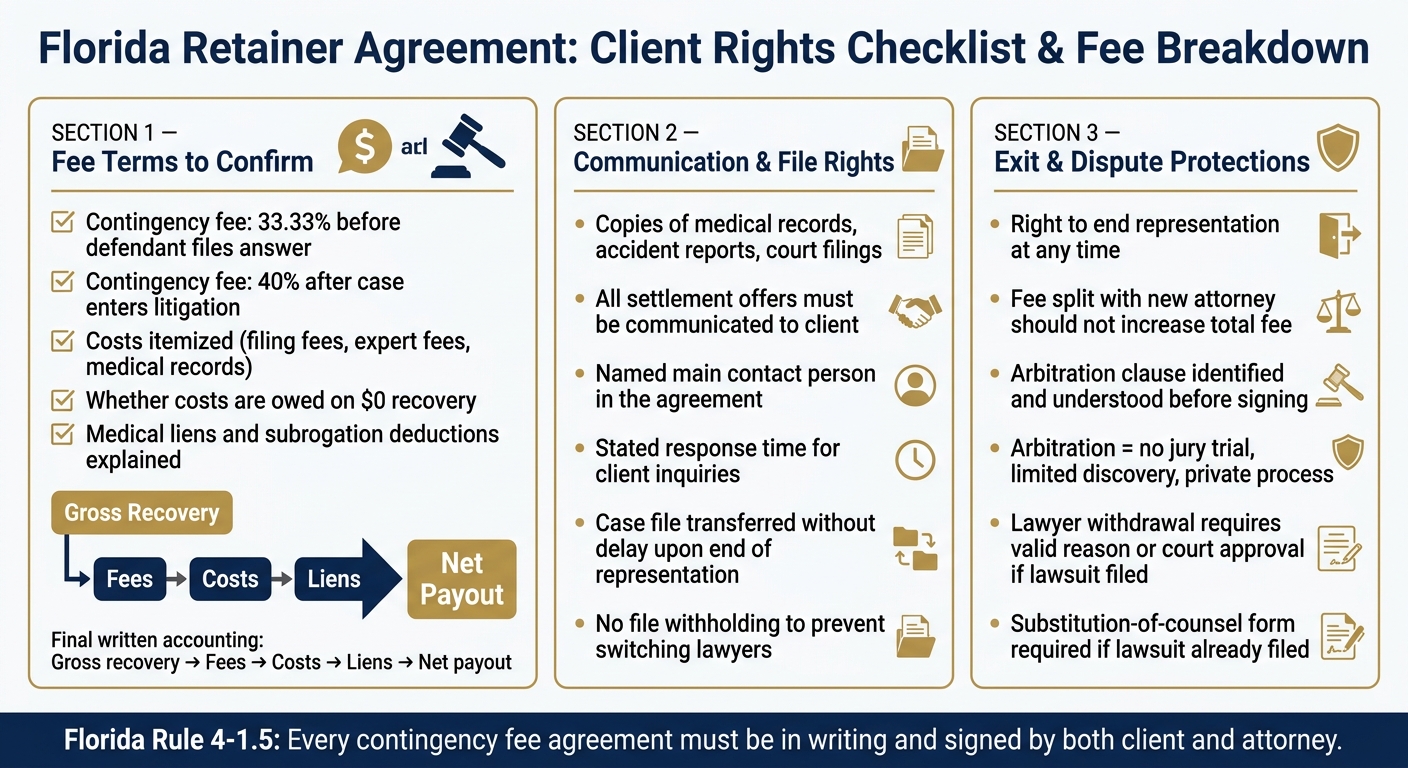
Florida Retainer Agreement: Client Rights Checklist & Fee Breakdown
Once you understand the risks, the next step is simple: know what your agreement needs to protect before you sign it.
The three trouble spots here are fees, communication, and termination. And each one lines up with a client right that should be spelled out in the contract.
The Right to a Written and Clear Fee Agreement
Under Rule 4-1.5 of the Florida Rules of Professional Conduct, every contingency fee agreement must be in writing.
That agreement should clearly say:
- the fee percentage
- when that percentage applies
- who pays case costs
Here’s the key point: no recovery means no attorney fee. But case costs are separate from attorney fees. So the agreement should plainly say whether you still owe those expenses if the case ends with no recovery. That’s not a small detail. It can mean the difference between walking away with no fee owed and still getting a bill for out-of-pocket costs.
| Protection Feature | What It Means for You |
|---|---|
| Written Contract Requirement | Must be in writing and signed by both you and your attorney |
| Negotiability of Percentage | You can negotiate the rate before signing, subject to state caps |
| Cost Responsibility (No Recovery) | The agreement should state whether you owe out-of-pocket costs if nothing is recovered |
| Refund Rules | Unearned fees must be returned; contingency fees are only earned upon recovery |
If the fee terms are fuzzy, that’s a red flag. You should be able to read this part of the contract and know, in plain English, how the money works.
Fee clarity should carry over to updates, records, and the final payout statement too.
The Right to Updates, Document Copies, and Clear Accounting
You’re entitled to copies of key case documents, including medical records, accident reports, witness statements, and court filings.
You also have the right to hear about settlement offers. Your lawyer can advise you, but the offer still has to be passed on to you. And when you ask questions, you should get steady, direct answers – not silence, vague replies, or endless delays.
When the case ends, you have the right to a final written accounting. That accounting should show:
- the gross recovery
- fees
- costs
- liens
- the net amount
Think of it as the case’s closing receipt. You should be able to see where every dollar went.
The Right to End Representation and Retrieve the Case File
The same plain dealing should apply if the relationship ends.
If you end representation, your case records should be transferred to you or your new attorney without delay. Any fee split should match the work actually done. And if the firm says you still owe costs, it still should release records needed to avoid delay.
That matters more than many people think. A file isn’t just paperwork sitting in a folder. It may include medical records, reports, filings, and other items your new lawyer needs to keep the case moving.
Before signing, compare these rights to the contract line by line.
How to Review a Retainer Agreement Before You Sign
Read the contract line by line before you sign it. Treat the client rights above like a checklist. This isn’t the place to skim.
Check the Numbers, Percentages, and Cost Responsibility Line by Line
Start with the money. Check the exact fee percentage, when that percentage changes, and whether costs come out before or after the fee is figured.
Then find the part that covers case costs. These are separate from attorney fees. They can include court fees, expert fees, medical records, travel, and admin costs. The agreement should spell out whether those costs are deducted before or after the fee is calculated. It should also say whether you still owe those costs if the case ends with no recovery.
If medical bills, liens, or subrogation claims are tied to the settlement, ask how those will show up in the closing statement. That part matters more than people think. A settlement can look one way on paper and feel very different once each deduction comes out.
After that, move to what happens if the working relationship ends.
Read the Termination, Withdrawal, and Arbitration Language Carefully
Check how the agreement deals with withdrawal, file transfer, and fee splits. The contract may still say that you must pay for costs already spent, and the first lawyer may still have a claim for payment based on work already done.
Also look for any language about when the lawyer can withdraw from an active case. In most situations, lawyers need a valid reason or court approval to step away. If a lawsuit has already been filed, a substitution-of-counsel form may need to be filed.
If you change lawyers, ask how any fee split will work so the total fee does not increase. That’s a big one. You don’t want a switch to quietly make the overall bill larger. Also note that a lawyer may delay releasing records until a fee or cost dispute is settled. Check when the file must be released after a dispute or substitution.
If the contract sends disputes to arbitration instead of court, the process changes in ways that matter. Court cases usually allow fuller discovery and appeal rights. Arbitration is private, but it’s also more limited.
Ask for Plain-Language Revisions Before Signing
If a clause feels fuzzy, ask for a written fix before you sign. Verbal promises are easy to make and easy to forget.
Ask for written revisions on points like:
- how often you’ll get updates
- who your main contact will be
- who will actually handle the case
- how liens will be handled
- whether "no fee" also means no costs
You can also ask for a sample settlement breakdown. That lets you see how fees, costs, and liens would be taken out of a final check. It’s one of the easiest ways to spot problems before they become your problem.
Conclusion: What a Fair Retainer Agreement Should Give You
After you review the contract line by line, the bottom line is simple: you should know exactly what you’re signing. A fair retainer agreement spells out fees, costs, and exit terms in plain English. It should also say whether litigation expenses can still apply if there is no recovery. A fair retainer agreement protects your fee, your file, and your right to end the relationship.
The agreement should also state the fee cap and when it changes. If something feels unclear, ask before you sign. Free consultations give clients time to review every term first.
Key Takeaways for Injury Clients and Families
Use this as your final signing checklist. Before you sign, confirm these terms:
- Clear money terms – fee percentage, costs, and final accounting
- Fair file access – how your case records will be transferred if you change lawyers
- Clear termination terms – your right to end representation at any time without increasing the total fee
Sign only when you understand each point. It helps protect your recovery.
FAQs
Can I negotiate a retainer agreement before signing?
Yes. You can – and should – go over your retainer agreement before you sign it.
During your first meeting, ask about the fee structure, case costs, and payment terms. You also have the right to understand the terms and conditions of your representation in plain English.
Ocala Injury Law puts a strong focus on transparency and one-on-one attention, so clients know what they’re agreeing to before moving forward.
What happens to my case file if I change lawyers?
If you decide to switch lawyers, your new attorney will usually handle the case-file transfer with your former counsel. You should still notify your old lawyer in writing that you want to change representation.
One thing to watch for: your former lawyer may keep the file until unpaid fees or case expenses are settled. And if a lawsuit has already been filed, you’ll also need to submit a Substitution of Counsel form with the court.
Do I owe case costs if I recover nothing?
In a contingency fee agreement, you usually don’t pay attorney fees if you recover no compensation.
That said, case costs are a separate issue. Expenses like court filing fees, expert witness charges, and medical record retrieval costs may still come into play. Whether you owe those costs depends on your retainer agreement.
Some law firms front these expenses during the case. But if your case doesn’t succeed, you may still have to repay them.