
Most personal injury claims end without trial, and the usual path is simple: prove fault, total the losses, send a demand, push back on low offers, and sign only when the numbers and terms make sense. If I were explaining it fast, I’d say settlement talks usually turn on 4 people – you, your lawyer, the insurance adjuster, and sometimes the other side’s lawyer – and 3 stages: case review, offer exchange, and mediation or final agreement.
Here’s the short version:
- I start with proof. That means medical records, bills, the police report, photos, witness statements, and lost-pay records.
- I wait until your condition is stable when possible. Settling too early can leave future treatment costs out of the deal.
- I total both types of losses. That includes money losses like medical bills and lost income, plus pain, emotional harm, and loss of enjoyment of life.
- I look at fault rules and insurance limits. In Florida, your share of fault can reduce what you get, and being more than 50% at fault can block recovery.
- I expect a low first offer. That is common. The reply is proof, not panic.
- I check the release before anyone signs. Once signed, the claim is over, so liens, fees, payment timing, and insurer payback claims must be reviewed.
A few facts matter here. Many civil cases settle before trial, and insurance carriers often try to close claims early for less than the case may be worth. That is why timing, documentation, and net recovery matter just as much as the headline settlement number.
If you want the plain answer, it’s this: lawyers negotiate settlements by building the case first, pricing the claim with records, and using pressure points like trial prep and mediation when the insurer resists.
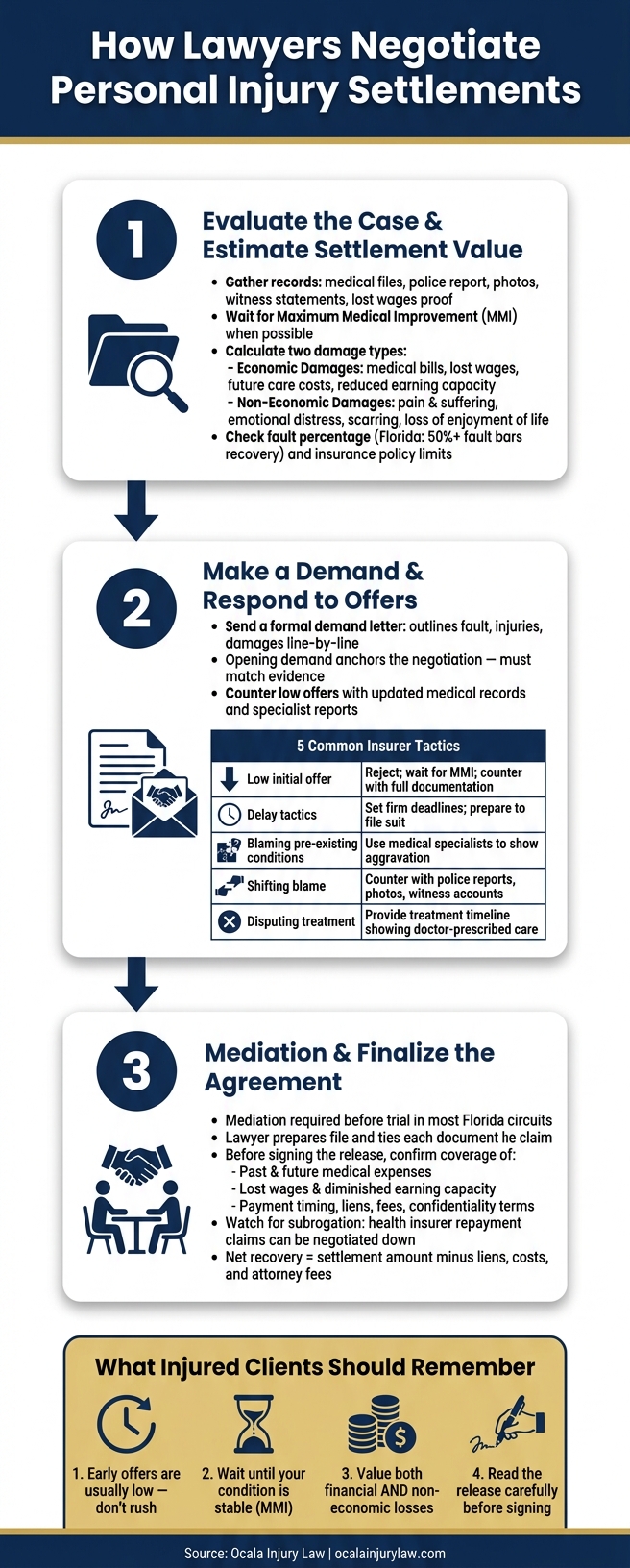
How Lawyers Negotiate Personal Injury Settlements: 3-Step Process
Step 1: Evaluate the Case and Estimate Settlement Value
A lawyer starts by taking a hard look at the whole case. The first job is simple: figure out who caused the harm and how much damage it caused.
Gather Records and Prove Liability
To prove negligence, your lawyer must show duty, fault, causation, and loss. That means pulling together the records that tell the story from start to finish.
Key records usually include:
- Medical files and billing records
- The police report
- Photos
- Witness statements
- Proof of lost wages
Lawyers also often wait until maximum medical improvement (MMI). That’s the point where more treatment is unlikely to improve the condition. If a case settles before MMI, it can be harder to account for future care, long-term medical needs, and other losses that may stick around.
Calculate Damages and Set a Negotiation Range
Next, your lawyer puts a dollar range on the claim. This is where the case moves from “what happened?” to “what is it worth?”
Damages usually fall into two categories:
| Damage Type | What It Covers |
|---|---|
| Economic Damages | Past and future medical bills, physical therapy, nursing care, lost wages, reduced earning capacity, out-of-pocket costs |
| Non-Economic Damages | Pain and suffering, emotional distress, scarring, mental anguish, loss of enjoyment of life |
Florida reduces recovery by your fault percentage, and fault above 50% bars recovery. So if you were partly at fault, that can cut the amount you can collect. Your lawyer will also check policy limits and uninsured/underinsured motorist coverage, because the settlement range is often limited by the insurance money on the table.
That number range becomes the starting point for the demand letter and the back-and-forth that comes after it.
sbb-itb-68ed374
Step 2: Make a Demand and Respond to Offers
Once the lawyer has a value range, that work turns into a formal demand. This is where talks start for real. And the first demand matters because it sets the tone for everything that follows.
Build a Strong Demand Letter
The demand letter is the first official ask. It lays out what happened, why the other side is legally at fault, how you were hurt, and how your treatment has unfolded over time.
It also includes a line-by-line breakdown of the damages you’re claiming, such as:
- Medical bills
- Lost wages
- Future care costs
- Pain and suffering
The full demand package also pulls in the main evidence that backs up liability and damages. The opening number should leave room to negotiate, but it still has to match the evidence. That number becomes the starting point, and it helps anchor the back-and-forth that comes next.
Use Strategy During Counteroffers
Insurers often come back low. That’s common. When that happens, your lawyer answers with more support: updated medical records, specialist reports, and proof of your ongoing limits.
That extra documentation gives weight to a stronger counteroffer. It shows, in plain terms, why the claim should be paid at a higher amount.
A lawyer who is ready for trial puts real pressure on the insurer. A lawyer who is ready for trial gives the insurer a real reason to increase the offer.
Common Insurer Tactics and How Lawyers Respond
Insurance adjusters tend to use the same playbook again and again. Once you know the pattern, their moves are a lot less mysterious.
| Insurer Tactic | Lawyer Response |
|---|---|
| Low initial offer – push for a quick settlement before injuries are fully known | Reject and wait for MMI; counter with a fully documented demand |
| Delay tactics – slow responses | Set firm deadlines; prepare to file suit to show serious intent |
| Blaming pre-existing conditions – claiming injuries aren’t from the accident | Use medical specialists to show the accident aggravated a pre-existing condition |
| Shifting blame – arguing the victim was partly at fault | Counter with police reports, photos, and witness accounts to establish liability |
| Disputing treatment – claiming care was unnecessary or excessive | Provide a clear treatment timeline showing prompt, doctor-prescribed treatment |
Adjusters often label an early offer the "best you can get." That’s pressure, not proof.
"best you can get."
If the insurer still won’t budge, the next move is usually mediation or a settlement conference.
Step 3: Use Mediation When Direct Talks Stall and Finalize the Agreement
When direct talks hit a wall, mediation gives both sides one last structured shot to close the gap. In most Florida circuits, mediation is required before a case can move to trial.
Prepare for Mediation or a Settlement Conference
Before mediation starts, your lawyer gets the file in order and builds a clear outline of the evidence. That means tying each document and witness back to the claim in a way that’s easy to use during the session.
Why does that matter? Because when the defense pushes back with fault claims or medical-history arguments, your lawyer needs to respond on the spot. Good prep makes that possible. It also helps your lawyer deal with fault and preexisting-condition arguments without giving up too much too soon.
Review the Settlement Terms Before Signing
Once both sides agree on a number, the focus shifts from negotiation to the release. Before you sign anything, make sure your treatment is stable. A settlement release ends the claim, so your lawyer needs to review every term with care.
Your lawyer should confirm that the agreement covers the full scope of damages, including:
- Past and future medical expenses
- Lost wages
- Diminished earning capacity
They should also check payment timing, liens, fees, and any confidentiality terms before the deal is final. Just as important, your lawyer will calculate your net recovery after liens, costs, and fees.
One issue that catches many clients off guard is subrogation. That’s when a health insurer seeks repayment for bills it already covered and takes that money from the settlement. A lawyer can often negotiate those claims down, which can leave more money in the client’s pocket.
After the release is signed and liens are resolved, the case moves to payment and closure.
Conclusion: What Helps Lawyers Negotiate Fair Settlements
The big takeaway from the steps above is pretty simple: fair settlements come from solid preparation. That means building strong evidence, putting an accurate dollar value on the claim, and staying firm through each part of the process, from valuation to the demand letter to the back-and-forth of negotiation.
Trial readiness matters too. When a lawyer prepares a case as if it could end up in court, that sends a clear message to the insurance company. It shows the claim isn’t being pushed with empty threats. And when an insurer sees that your lawyer is ready to file suit and take the case all the way, offers often start to improve.
If you need help putting these steps to work in your own claim, Ocala Injury Law offers free consultations and personalized support.
Key Takeaways for Injured Clients
For injured clients, a few rules matter most:
- Early offers are usually low. Insurers often move fast because a quick settlement usually helps them, not you.
- Wait until your condition is stable. If you settle before MMI, you may not know the full cost of your injuries yet.
- Value both financial and non-economic losses. A fair settlement should cover medical bills, lost wages, future care, and non-economic losses like pain and suffering.
- Read the release before signing. Once you sign it, the claim is final.
FAQs
How long do settlement negotiations usually take?
Settlement talks can look very different from one case to the next because no two cases are the same.
After your attorney sends a demand letter, the insurance company may take several weeks – or sometimes a couple of months – to respond.
From there, the back-and-forth often continues with counteroffers and more discussion, which can stretch the timeline even more.
Should I accept the first settlement offer?
Usually, no.
The first settlement offer is often low. Insurance companies tend to make these early offers to close a claim fast, before the full scope of your injuries or long-term losses is clear.
There’s another catch: accepting the offer usually means signing a release. Once you do that, you may give up your right to ask for more money later, even if your medical bills grow or your recovery takes longer than expected.
Ocala Injury Law can review the offer, explain what it may mean for your case, and help you seek compensation based on your documented losses.
What happens if the insurer refuses to settle?
If the insurance company won’t settle, your attorney may move the case to mediation. That’s a process where a neutral third party helps both sides try to reach an agreement.
If mediation doesn’t settle the matter, your lawyer can keep pushing your claim and, if needed, get the case ready for court. At Ocala Injury Law, the team is ready to fight for the compensation you deserve.