
If you were hurt by someone else, a claim usually comes first, and a lawsuit comes later only if settlement talks fail. In plain terms, a claim is an insurance process. A lawsuit is a court case. Both aim to recover money for losses like medical bills, lost pay, property damage, and pain and suffering.
Here’s the short version:
- A personal injury claim is made with the insurance company.
- A personal injury lawsuit is filed in civil court.
- Claims often cost less and may end in weeks to several months.
- Lawsuits often take months to years.
- In Florida, the filing deadline is 2 years for accidents on or after March 24, 2023.
- Lawsuits often add costs like court filing fees, deposition costs, and expert witness fees.
- Attorney contingency fees often fall around 33% to 40% of the recovery.
- Most cases settle before trial, but filing suit may be needed if the insurer denies the case, makes a low offer, or the deadline is close.
If I had to boil it down even more: a claim gives you more say during settlement talks, while a lawsuit puts the case under court rules and leaves the outcome to a judge or jury.
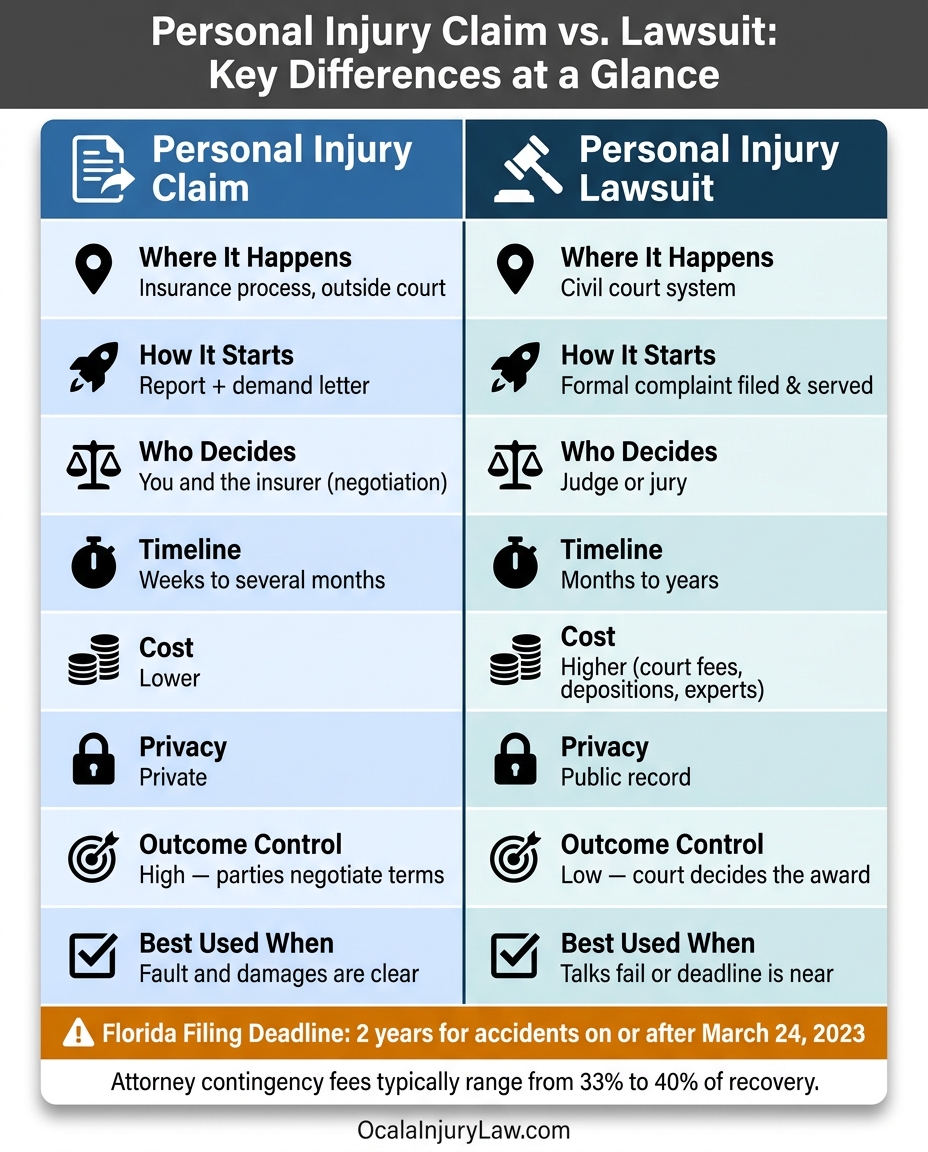
Personal Injury Claim vs. Lawsuit: Key Differences at a Glance
Quick Comparison
| Point | Personal Injury Claim | Personal Injury Lawsuit |
|---|---|---|
| Where it happens | Insurance process, outside court | Civil court |
| How it starts | Report, records, demand letter | Complaint filed and served |
| Who decides | You and the insurer through settlement talks | Judge or jury if no settlement |
| Time range | Weeks to several months | Months to years |
| Cost | Lower | Higher |
| Privacy | Private | Public record |
| Risk | Lower process risk | More uncertainty in outcome |
| Best time to use | When fault and damages are clear | When talks fail or time is running out |
The main takeaway: before choosing a path, I’d look at fault, injury severity, proof, settlement offers, and time left before the deadline.
sbb-itb-68ed374
What a Personal Injury Claim Involves
A personal injury claim is a request for payment from the person who caused the injury or that person’s insurance company. Most claims are handled through negotiation, which means the case often stays out of court unless those talks fall apart.
The process usually includes reporting the incident, getting medical treatment, tracking your losses, sending a demand letter, and negotiating before the filing deadline runs out. In Florida, that deadline is two years for accidents that happened on or after March 24, 2023.
Who Is Involved and How a Claim Starts
Three parties usually shape the claim.
- The injured person, also called the claimant, seeks payment for damages.
- The insurance adjuster reviews the claim for the insurer’s side, not yours.
- A personal injury attorney collects evidence and pushes for a fair payout, often without going to court unless it becomes needed.
The claim begins when the insurer is told about the incident. After that, the claimant starts building the case with records that back up the losses. That can include medical records, medical bills, wage loss statements, repair estimates, and receipts for out-of-pocket costs.
How a Personal Injury Claim Can End
Once the insurer looks over the evidence, the claim usually heads toward a settlement, more back-and-forth, or a denial. After the records are in place, the attorney sends a demand letter. That letter lays out the facts, the damages, and the exact amount of money being requested.
A claim can end in a few ways: settlement, denial, requests for more proof, or counteroffers before both sides agree. If a settlement is reached, the claimant accepts payment and signs a release of liability. That release ends the claim and blocks any more payment for the same injury.
Timing matters here. Settling too soon, before medical treatment is finished, can leave bills and other costs unpaid. Future medical care is often hard to pin down until treatment is complete.
If the claim doesn’t settle, the case can move into a lawsuit.
What a Personal Injury Lawsuit Involves
If a claim doesn’t settle, the dispute moves out of back-and-forth talks and into court. At that point, filing a lawsuit is the next move. A personal injury lawsuit is a civil case where a judge or jury decides how much compensation should be paid.
That shift matters. The case is no longer controlled by insurer negotiation. It moves under the court’s timeline and rules. Once the lawsuit is filed, it usually goes through pleadings, discovery, and pretrial practice.
The case starts with a complaint filed in civil court. That document names the defendant and states the damages being sought. After that, the defendant is served with the complaint and a summons.
The Main Stages of a Lawsuit
After the pleadings, the case enters discovery. This is the stage where both sides exchange evidence through depositions, interrogatories, and document requests. Discovery usually lasts 6 to 12 months, and it often brings out facts that didn’t come up during the claim stage.
Next come pre-trial motions. Here, attorneys ask the court to decide certain legal issues before trial starts. Courts also often require mediation or another form of alternative dispute resolution before trial. That gives both sides one more shot at settling the case.
A lot of lawsuits end at this point, without ever reaching a jury.
Why Lawsuits Take Longer and Cost More
This is why lawsuits move slower and cost more than claims. Discovery, motions, and mediation can add months before anyone steps into a courtroom for trial.
The costs go up too. Litigation can include:
- Court filing fees
- Expert witness fees
- Deposition costs
Those expenses don’t usually exist during the claim stage. Attorneys still tend to work on a contingency fee basis, usually 33% to 40% of the final recovery. But when a case goes to trial, the total amount taken from a settlement or verdict is often higher because of those added case costs.
The tradeoff is pretty plain. A lawsuit puts formal legal pressure on the other side, and it can lead to a larger recovery, especially when the insurer started with a low settlement offer.
Personal Injury Claims vs. Lawsuits: Key Differences
When a claim stops moving, the next step usually comes down to this: keep negotiating, or file in court. A claim stays outside the court system. A lawsuit puts the case in front of the civil court. That one move changes control, cost, timing, and risk.
These differences hit hardest when settlement talks go nowhere.
Comparison of Personal Injury Claims and Lawsuits
| Feature | Personal Injury Claim | Personal Injury Lawsuit |
|---|---|---|
| Process Location | Outside of court, usually through an insurance company | Civil court system |
| Initiation Step | Filing a claim and sending a demand letter | Filing a formal complaint and serving the defendant |
| Decision-Maker | Negotiated by the injured person and the insurer | A judge or jury decides the award |
| Timeline | Weeks to several months | Months to years |
| Costs | Lower – negotiation-based | Higher – court fees, discovery, expert witnesses |
| Privacy | Private settlement talks | Public record |
| Outcome Flexibility | High – parties negotiate the terms | Low – the court decides the award |
Timing, Risk, and Control: How the Two Options Compare
The biggest difference is simple: who has the final say.
With a claim, you keep more of that control. You can reject a low offer, make a counteroffer, and walk away if the deal falls short. It’s more like a back-and-forth business discussion.
A lawsuit changes that. Once the case moves toward a judge or jury, the result is much harder to predict. They might award more than the insurer offered. They might award less. They might award nothing at all.
That’s the tradeoff. A lawsuit puts formal legal pressure on the other side and can open the door to more compensation. But it also brings a new layer of risk if a jury decides the defendant was not liable.
When Filing a Lawsuit Is Needed to Protect Your Case
Sometimes filing a lawsuit isn’t about rushing to trial. It’s just a way to protect the case.
In many situations, filing is a defensive step. It preserves your right to seek compensation before the filing deadline runs out, even if settlement talks are still happening.
Choosing the Right Path and What Comes Next
Once you understand the difference between a claim and a lawsuit, the next step is figuring out which route gives you the best shot at recovering what you’ve lost. There’s no one-size-fits-all answer. It depends on who is at fault, how badly you were hurt, how strong your proof is, and how much time you have left to file.
When Settling a Claim Without a Lawsuit Makes Sense
A claim is usually the first step to seek compensation without going to court. It makes the most sense when fault is clear and your damages are backed up with solid records.
Timing can make or break the outcome. It’s usually smart to wait until you reach maximum medical improvement, which means your condition has stabilized and your future medical needs and losses are easier to estimate. If you settle too soon, you may leave money on the table. Once you sign a release, you generally can’t come back later and ask for more.
If the insurance company won’t offer a fair amount, filing a lawsuit may be the next move.
When Filing a Lawsuit Is the Better Option
A lawsuit may be the better path when the insurer refuses to settle fairly or your filing deadline is getting close. That often includes denied claims, lowball offers that don’t cover your actual damages, serious or permanent injuries that an insurer may undervalue, and cases where fault is in dispute.
When talks have stalled and time is running short, filing suit can help protect your claim.
Conclusion: What to Remember About Claims and Lawsuits
The decision often comes down to value, risk, and timing. Your best path depends on the facts of the case, the seriousness of your injuries, how the insurer is handling the matter, and how long you have left to file. If you’re not sure which option fits your situation, Ocala Injury Law offers free consultations to help you decide before deadlines run out.
FAQs
Should I accept the first settlement offer?
Generally, no. Insurance companies often make first offers that are far below what a claim is actually worth.
Once you accept a settlement, it’s legally binding. In most cases, that means you give up the right to ask for more money later, even if your injuries get worse or new damage shows up.
Before you sign anything, finish your medical treatment and talk with an attorney. Ocala Injury Law offers free consultations.
Can I file a lawsuit while settlement talks continue?
Yes. You can file a lawsuit even while settlement talks are still going on if you can’t get an agreement that works for you with the at-fault party or their insurance company.
Filing a lawsuit does not shut down settlement discussions. In many cases, both sides still keep talking after the case is filed. That can include mediation, settlement conferences, and direct negotiations.
What happens if I miss the filing deadline?
Missing the filing deadline – called the statute of limitations – will usually get your claim permanently dismissed.
In Florida, most personal injury lawsuits for injuries that happened on or after March 24, 2023 must be filed within two years. Courts enforce this deadline strictly. If you miss it, you generally lose the right to seek compensation.