
If I file a personal injury case in the wrong court or county, I can lose time, spend more on motions, or even lose the claim if the deadline runs out.
Here’s the short answer: jurisdiction means the court has the power to hear the case, and venue means I filed it in the right place. In many injury cases, I need to check where the accident happened, where the defendant lives or does business, and whether state or federal court fits. If any of those are off, the case may be transferred or dismissed.
A few points matter right away:
- Personal jurisdiction: does the court have power over the defendant?
- Subject matter jurisdiction: can that court hear this kind of case?
- Venue: is this the right county or district?
- Federal court: may apply if there is a federal law issue or diversity jurisdiction
- Timing: filing mistakes can be serious because every state has a statute of limitations
In plain English: a strong case can still hit a wall if it starts in the wrong court. That is why these issues often come up at the very start, before the court gets into the facts.
Quick comparison
| Issue | What I look at | What can happen if it’s wrong |
|---|---|---|
| Jurisdiction | Court power over the case or defendant | Dismissal |
| Venue | Right county or district | Transfer or dismissal |
| State vs. federal court | Type of claim and parties’ location | Delay, motion fights, court change |
| Out-of-state defendant | Contacts with the state | Case may need to move |
| Filing deadline | Time left before the legal deadline | Claim may be barred |
About 95% of personal injury cases settle before trial, but the court still has to be the right one before the case can move ahead. And in the federal system alone, there were more than 260,000 civil case filings in recent years, which shows how much procedure matters from day one.
If I want a case to stay on track, I need to get jurisdiction, venue, and filing choice right from the start.
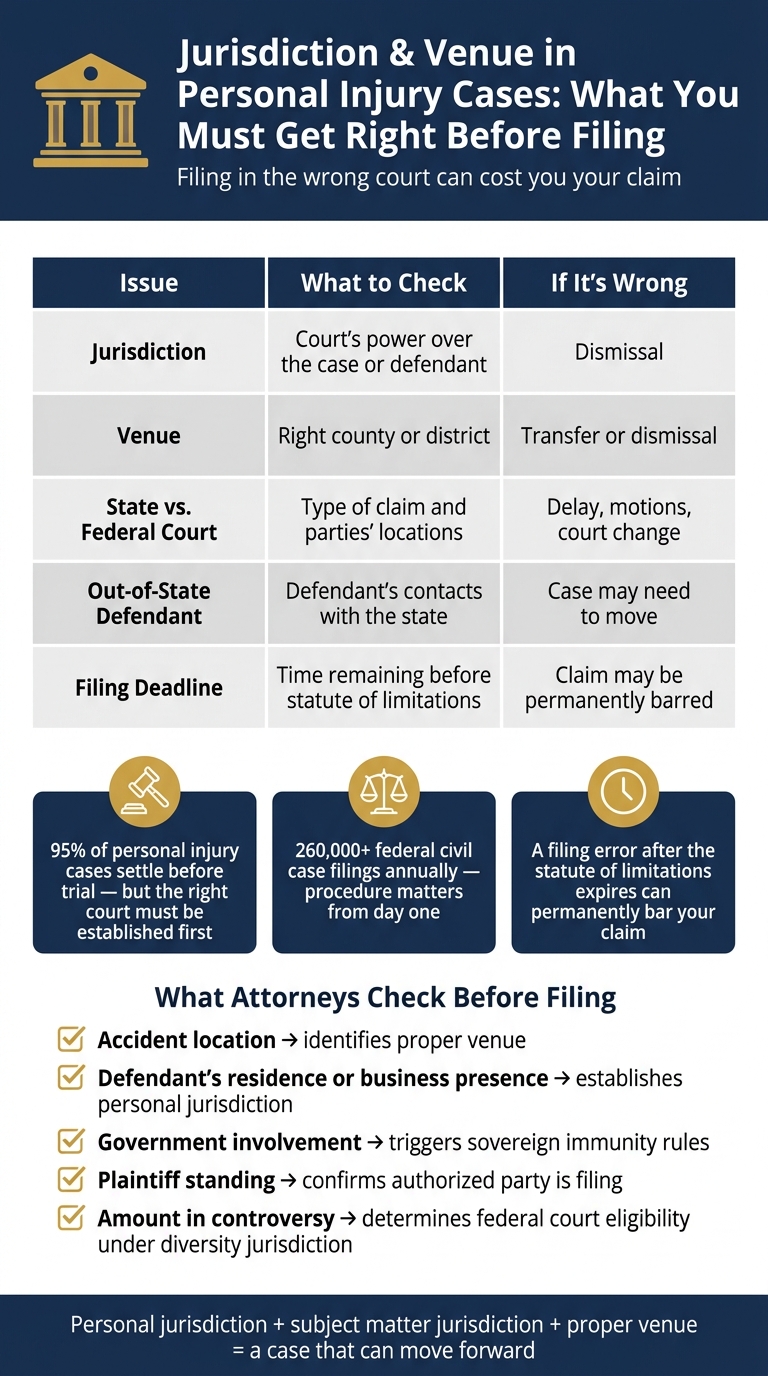
Jurisdiction vs. Venue in Personal Injury Cases: Key Differences & Consequences
Where a Personal Injury Case Can Be Filed
After jurisdiction and venue are sorted out, the next step is figuring out which court has authority over both the defendant and the claim. In most personal injury cases, that means filing in the state with the closest link to the accident, usually where the injury happened or where the defendant lives or does business.
The catch? These rules come from state law, and they change from one state to another.
Personal Jurisdiction and Subject Matter Jurisdiction
Before filing, there are two separate issues to answer.
- Personal jurisdiction asks whether the court has power over the defendant.
- Subject matter jurisdiction asks whether the court can hear a personal injury or wrongful death case at all.
That split matters because it helps decide whether the case belongs in state court, federal court, or even a different county. Both have to be in place.
A court may be allowed to hear personal injury claims in general, but still lack power over a certain out-of-state defendant. When that happens, the case can stall or may not be able to move ahead in that court.
Common Filing Locations in State Court
In many situations, the filing location connects to where the injury happened or where the defendant lives or does business. That’s the usual starting point.
If the defendant is from out of state, the court has to take a closer look at jurisdiction. In those cases, the defendant’s contacts with the state can make or break where the suit may be filed.
When Federal Court Is an Option
Federal court can be an option in two main situations: when diversity jurisdiction applies or when the case involves a federal question.
That choice matters more than many people expect. It can affect:
- procedure
- filing deadlines
- motion practice
Federal court follows federal procedure. At the same time, state law still controls many substantive issues in diversity cases.
The filing decision can also shape how soon early motions show up and how much delay a jurisdiction fight might cause.
sbb-itb-68ed374
How Jurisdiction Can Change the Direction of a Case
Jurisdiction can shape both the speed of a case and whether a court gets to keep it at all.
A case might look straightforward at first. Then jurisdiction comes up, and suddenly the path changes. The court may need to decide where the case belongs before anything else can move forward.
How State Court and Federal Court Handle Cases Differently
State and federal courts follow different procedures, deadlines, and motion rules. That can change how fast a case moves.
In plain English: the same dispute can play out on a different timeline depending on which court hears it. One court may move faster on motions. Another may have different filing rules or case schedules. Those differences can affect the day-to-day progress of the case.
Cases Involving Out-of-State Defendants
When the defendant lives or does business in another state, the court still needs personal jurisdiction before the case can stay there.
That issue often becomes a turning point early on. If the court has personal jurisdiction, the case may stay where it was filed. If not, the case may have to move to a different court.
Early Disputes That Slow a Case Down
Jurisdiction fights can stall a case at the start and lead to extra motion practice.
If the case is filed in the wrong court or county, the result may be a transfer or dismissal. That means more briefing, more delay, and more time spent sorting out where the case belongs before the parties can get into the heart of the dispute.
What Happens When a Case Is Filed in the Wrong Court or County
Filing in the wrong court or county can slow everything down. In some cases, it can also prevent recovery.
Improper Venue: Transfer or Dismissal
If the case was filed in the wrong place, the next issue is simple: Does it move, stay, or end?
When a case is filed in the wrong county or court, the defendant can object early in the litigation. That objection often leads to one of two results: the court transfers the case to the proper venue, or it dismisses the case. Which outcome applies depends on the procedural rules that govern the court.
A venue problem can exist even when the court has jurisdiction. That’s the part that trips people up. A court may have the power to hear the type of case, but the filing location can still be wrong.
How a Filing Error Can Be Corrected
The usual fix is either a transfer or refiling in the correct court. Either way, the mistake costs time, and that delay can matter a lot.
The statute of limitations is what makes timing so important. If a case is dismissed after the deadline has passed, the plaintiff may lose the claim. A filing mistake that could have been fixed early can turn into a dead end if no one catches it in time.
Proper Venue, Improper Venue, and Transfer Compared
| Situation | What it means | Likely result |
|---|---|---|
| Proper venue | The case was filed in the correct court or county | The case usually proceeds where it was filed |
| Improper venue | The filing location does not meet the venue rules | The defendant may object, and the court may transfer or dismiss the case |
| If transferred | The case is moved to the proper court or county | The case continues in the new court, usually after some delay |
A transfer can change more than the courthouse. It may also change the case schedule and the local rules.
Conclusion: Choosing the Right Court From the Start
Jurisdiction and venue aren’t minor filing details. They can shape where a personal injury case goes and how smoothly it moves.
File in the right court from day one, and the case stays on track. File in the wrong one, and you can lose weeks or even months dealing with avoidable procedural issues. That’s why attorneys check jurisdiction, venue, and filing authority before the complaint is filed.
What Attorneys Check Before Filing
Before filing, attorneys look at a short list of jurisdiction and venue issues. The main questions are below.
| Factor to Check | Why It Matters |
|---|---|
| Accident location | Helps identify the proper venue |
| Defendant’s residence or business presence | Helps establish personal jurisdiction |
| Government involvement | Triggers sovereign immunity rules and different procedures |
| Plaintiff standing | Ensures the correct party is authorized to file |
| Amount in controversy | Helps determine whether federal court is available under diversity jurisdiction |
Getting these details right before filing can help protect the client’s claim from delays and procedural traps. Ocala Injury Law reviews these issues before filing to help avoid procedural mistakes.
FAQs
How do I know which court should hear my injury case?
The right court usually depends on two main things: where the incident happened and how much money is at stake.
In Florida, for example, these cases are often filed in the circuit court of the county where the incident took place.
Jurisdiction rules can change from one place to another, so picking the right venue matters. If you file in the wrong court, your claim can run into delays or other problems before it even gets moving. Ocala Injury Law offers free consultations to help with this process.
Can my case be moved if the other side is out of state?
Yes. If the other party lives out of state, your case may be filed or moved to a different jurisdiction.
Jurisdiction usually depends on facts like where the accident happened and where each party lives. Those rules can get messy fast, and they change from state to state.
That’s why it helps to talk with a professional before you make any moves. Ocala Injury Law offers personalized support and free consultations to help you understand your options and protect your rights.
What if I filed in the wrong court before the deadline?
Filing a personal injury claim in the wrong court before the statute of limitations runs out is a serious mistake. But it doesn’t always mean you’ve lost your chance to seek compensation. Missing the deadline altogether is a different story. That can permanently block your claim.
Jurisdiction issues can get messy fast, and court rules aren’t the same everywhere. That’s why it’s smart to contact Ocala Injury Law right away. The firm offers personalized legal services and free consultations to help protect your rights.