
When drivers disagree, crash reconstruction can show what likely happened. I’d sum it up this way: these experts use scene marks, vehicle damage, black-box data, video, and physics to help sort out fault, injury cause, and case value.
Here’s the short version:
- They rebuild the crash using skid marks, debris, crush damage, and rest positions.
- They pull digital data like EDR/ECM records, dashcam video, phone records, and in-car system data.
- They test speed, braking, visibility, and reaction time to check whether a driver could have avoided the wreck.
- They help lawyers deal with disputed facts in truck crashes, multi-car pileups, rollovers, motorcycle wrecks, and wrongful death claims.
- They may help connect impact forces to injuries, often with input from biomechanical engineers.
- They must meet court rules such as Rule 702 and, in many courts, Daubert or Frye standards.
- Time matters. EDR data can be lost, skid marks can fade, and damaged vehicles can be repaired or scrapped within days.
A few facts matter here. According to NHTSA, traffic crashes in the U.S. kill tens of thousands of people each year, and many more cause injury. In serious wrecks, even a few seconds of pre-crash data can shape the whole case.
Quick comparison
| Part of the work | What the expert looks at | What it may help show |
|---|---|---|
| Scene review | Skid marks, gouges, debris, road layout | Point of impact, path of travel |
| Vehicle review | Crush damage, paint transfer, contact marks | Impact angle, force, contact sequence |
| Digital records | EDR/ECM, dashcam, phone data | Speed, braking, steering, distraction |
| Physics review | Momentum, stopping distance, friction | Pre-impact motion, avoidability |
| Injury review | Crash forces + medical records | Whether forces match claimed injuries |
| Court use | Report, diagrams, testimony | Support for fault and damages claims |
If I were reading this for practical help, my takeaway would be simple: the sooner the evidence is saved, the stronger the reconstruction can be. What follows is a plain-language look at how that process helps an injury case without relying only on memory or guesswork.
sbb-itb-68ed374
How Experts Reconstruct an Accident Step by Step
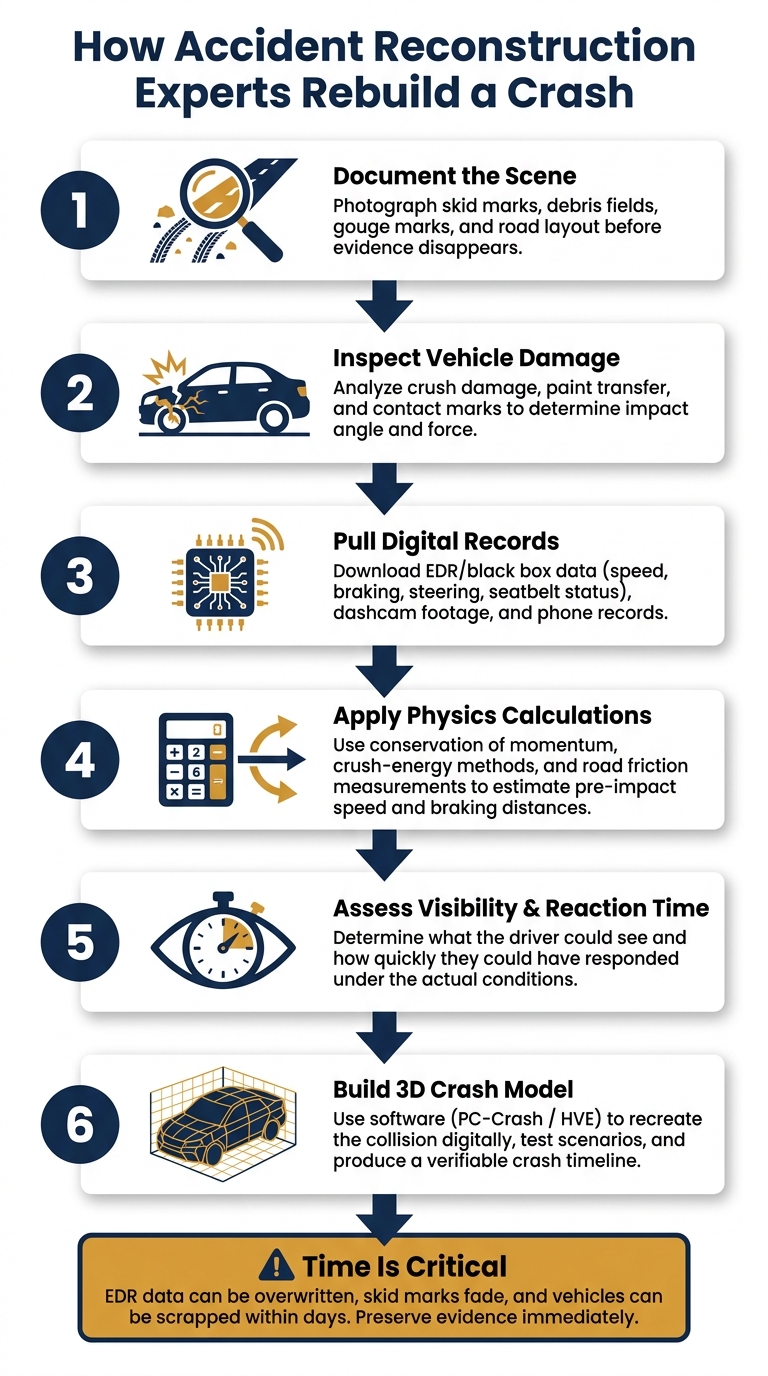
How Accident Reconstruction Experts Rebuild a Crash: Step-by-Step
Accident reconstruction uses physical evidence, measurements, and physics to piece a crash back together.
Scene Evidence, Vehicle Damage, and Digital Records
Experts start with the evidence that can vanish fast. Tire marks, debris fields, and gouge marks may disappear once the road is cleared or after rain, wind, or traffic passes through. That’s why the first job is to document the scene in detail.
Next comes the vehicle inspection. Experts look at crush damage and scratch patterns to figure out impact angles and the force involved in the collision. A bent panel or paint transfer can say a lot when you know what to look for.
They also pull EDR data for speed, braking, steering, and seatbelt status. Dashcam footage gets reviewed too. After that, experts line up witness statements against the physical evidence and the digital record. Those records then feed into the physics work that comes next.
Physics, Measurements, and Crash Modeling
From there, experts use conservation of momentum to estimate pre-impact speed and direction. They do this by looking at vehicle weights, impact angles, and the final rest positions of the vehicles. In plain English, they’re working backward from what happened after impact to estimate what happened just before it.
Crush-energy methods add another layer. These methods estimate the forces involved based on how much each vehicle deformed. The more damage, the more data there is to study.
Experts also look at driver reaction time and visibility. This helps answer two big questions: What could the driver actually see, and how fast could they respond? In braking cases, they measure road friction to calculate how fast a vehicle could have stopped under those road conditions.
The last step is 3D crash simulation. Using software like PC-Crash and HVE, experts build a digital recreation of the collision. They can view it from the driver’s perspective and run test scenarios. For example, they may test whether the crash still would have happened if one driver had been traveling at the speed limit.
The end product is a timeline that can be checked against each driver’s version of events. Put together, these methods turn raw evidence into crash findings that can be tested instead of guessed at.
Comparison Table: Common Reconstruction Methods
The table below compares the main reconstruction methods and what each adds.
| Method | Required Inputs | What It Can Show | Main Strengths | Common Limits |
|---|---|---|---|---|
| Skid-Mark Analysis | Mark length, road friction | Minimum speed from tire marks | Objective physical evidence | Minimum speed only; limited with ABS |
| Momentum Analysis | Vehicle weights, impact angles, final rest positions | Speeds from impact dynamics | Based on conservation of momentum | Requires precise rest-position data |
| EDR (Black Box) Data | Electronic download from vehicle computer | Speed, braking, and steering data | High-accuracy digital record | May be overwritten or inaccessible in older vehicles |
| 3D Simulation (PC-Crash / HVE) | Scene measurements, vehicle specs, physics data | Visual crash recreation | Useful in court presentations; supports test scenarios | Accuracy depends on input data quality |
Each method does a different job, so experienced reconstructionists often use several at once. No single method tells the whole story. But when the pieces line up, the case rests on science instead of clashing memories.
How Reconstruction Findings Help Prove a Legal Case
Reconstruction turns crash evidence into proof a lawyer can actually use. Instead of dueling stories, you get findings based on physics, measurements, and digital records. That matters because disputed facts can become admissible evidence.
Proving Liability and Causation with Objective Evidence
EDR data can show speed, braking, and steering in the seconds before impact. Cell phone records and in-car system data can help show whether a driver was using a phone or display before the crash. Impact angle can also help show who initiated contact.
That matters in court because eyewitness memory is often shaky. Trauma changes perception. Poor lighting, bad weather, and limited sight lines can make things even worse. Reconstruction leans on physical and digital evidence that existed at the moment of the crash, not on what someone thinks they saw afterward.
Under Rule 702, the expert’s methods must be reliable and applied the right way. When the reconstruction clears that bar, it can carry serious weight with a jury.
The same analysis can also help answer another big question: were the crash forces strong enough to cause the injuries being claimed?
Linking Crash Forces to Injuries and Damages
Once fault is addressed, the focus usually shifts to damages. Injury analysis looks at force, duration, and how the body moved during impact. Biomechanical engineers study whether the impact force, along with the time the body spent decelerating, was physically capable of causing the specific injuries claimed.
Low-speed crashes can still produce harmful G-forces, even when the vehicle damage looks minor. That’s a point many jurors may not expect at first glance. A bumper can look fine while a person’s body takes the hit in a very different way.
When this analysis is paired with medical records, reconstruction helps connect crash mechanics to the claimed injuries and damages. That link can support claims for medical treatment, future care, and lost earnings.
Pros and Cons Table: Reconstruction Testimony in Court
| Benefit | Limitation | |
|---|---|---|
| Objectivity | Uses data, not memory | Eyewitness accounts can still conflict with findings |
| Clarity | Easy for juries to follow | Accuracy depends entirely on the quality of evidence preserved |
| Causation | Links forces to injuries | Experts may need to make assumptions when physical evidence is incomplete |
| Credibility | Adds scientific weight | Testimony must meet Daubert or Frye standards |
Court testimony helps, but it isn’t limitless. An expert can’t tell a jury that a driver was legally negligent. That’s a legal conclusion, not a scientific one. The expert explains the facts. The court decides negligence.
When Attorneys Use Accident Reconstruction Experts
Cases That Often Need Reconstruction Analysis
Once reconstruction methods pin down what happened, attorneys put those facts to work in cases where people disagree about the crash. They often bring in reconstruction experts for complex or disputed claims, usually as early as possible after the wreck or during discovery. Not every accident calls for this kind of analysis. But when a case is messy or the facts are in dispute, it often does.
Common examples include:
- Rollover accidents
- Multi-vehicle chain reactions
- High-speed collisions
- Commercial truck crashes
- Motorcycle crashes
- Pedestrian impacts
- Distracted driving cases
In these situations, reconstruction can sort out the impact sequence, visibility, and how each driver responded. That’s why early documentation matters so much.
Why Early Evidence Preservation Matters
These cases depend on fast action because the most useful evidence tends to disappear first. Skid marks fade. Debris gets cleared away. Weather can change road conditions. Vehicles may be towed, repaired, or salvaged before anyone gets a close look.
EDR data is especially time-sensitive. Event Data Recorder data should be secured right away, since it can be overwritten or lost if the vehicle is driven again or destroyed. Digital evidence needs that same urgency. Cell phone records, infotainment system data, and smartphone app activity can be overwritten or deleted if they aren’t preserved fast. Photos, drone footage, and 3D scans help lock in scene conditions before they change.
How Ocala Injury Law May Coordinate Expert Support

When reconstruction is needed, the next step is getting the right experts and records in place. These claims are strongest when expert findings, medical records, and witness statements point in the same direction. Ocala Injury Law gives personal attention to injury cases and may work with specialized forensic engineers when reconstruction is part of the case. The aim is to turn raw evidence into clear support for settlement or trial.
Conclusion: The Role of Reconstruction Experts in Injury Claims
In injury claims, reconstruction matters for one main reason: it turns crash evidence into proof.
Accident reconstruction experts use physics and physical evidence to show how a collision happened. That work can help sort out liability through speed calculations, braking patterns, and driver reaction times. The same evidence can also show the force of impact.
Causation comes into play when biomechanical engineers review whether the impact forces were enough to cause the injuries being claimed. Reconstruction can also help link crash severity to the injuries and losses in the case.
Acting fast after a crash can make a big difference. Key evidence can disappear quickly, and preserved evidence is what keeps reconstruction reliable.
Ocala Injury Law offers free consultations and personalized attention in injury cases that call for reconstruction analysis. Early legal action helps preserve the evidence reconstruction relies on.
FAQs
When is accident reconstruction needed?
Accident reconstruction comes into play when liability or damages are disputed in more complex motor vehicle, truck, motorcycle, or slip-and-fall cases.
These experts are especially helpful when the evidence needs scientific analysis, eyewitness accounts are incomplete or unreliable, or there are open questions about fault, how a crash happened, or whether a low-speed impact caused the claimed injuries.
How soon should crash evidence be preserved?
As soon as possible after an accident. Speed matters here. Accident reconstruction depends on physical evidence and objective data, so the scene needs to be documented before those details fade, get cleaned up, or disappear.
That documentation can include photos or videos of vehicle positions, debris, skid marks, and digital evidence like event data recorder (EDR) information. If negligence may be involved, a formal preservation letter can help keep key evidence from being lost or destroyed.
Can reconstruction prove my injuries were caused by the crash?
Yes. Accident reconstruction experts study how the crash happened, and biomechanical engineers look at what those forces did to your body.
They calculate impact speeds and G-forces to help connect the crash to your specific injuries, even when the vehicle damage looks minor.