
An OSHA violation can help your injury case, but it does not win the case by itself. If I’m hurt at work, OSHA records may help show there was a hazard, the employer knew about it, and the hazard was tied to the injury. But I still need proof of causation, medical harm, and the right claim under state law.
Here’s the short version:
- OSHA does not pay injury money
- OSHA citations are not automatic proof of legal fault
- Workers’ comp usually blocks a lawsuit against the employer
- Third-party claims may still be possible
- Florida law decides how much OSHA evidence matters in court
- Early evidence can shape the outcome
A few points stand out fast:
- In Florida, injured workers usually must report the injury within 30 days
- Workers’ comp often pays about two-thirds of average weekly wages
- Workers’ comp does not pay for pain and suffering
- OSHA files that often matter include inspection reports, photos, training logs, OSHA 300 logs, SDS sheets, and abatement records
When I look at this topic in plain terms, the article comes down to three ideas:
- OSHA can help show a safety failure
- That safety failure still must be linked to the injury
- The type of claim controls how much that OSHA proof matters
| Claim type | How OSHA may help | What it does not do |
|---|---|---|
| Workers’ compensation | Helps show how the accident happened | Does not guarantee benefits |
| Claim against employer under a narrow state-law exception | May help show the employer knew of a grave danger | Does not bypass exclusivity by itself |
| Third-party injury claim | May support breach of the standard of care | Does not prove causation or damages |
If I were using this article as a guide, my first steps would be simple: get medical care, report the injury fast, keep photos and witness names, save records, and avoid giving statements before I understand how the OSHA issue and legal claim fit together.
The Problem: Workplace Injuries Are Hard to Prove Without Strong Safety Evidence
After a workplace injury, the fight often comes down to one thing: who was at fault. The employer may say the worker caused the accident. The worker may say basic safety steps were missing. When both sides tell a different story, OSHA records can provide the safety proof a claim needs.
Common Disputes After a Workplace Accident
Employers often lean on comparative fault under Florida law. That can cut a worker’s recovery if the worker is found partly to blame. A lot of these disputes focus on missing machine guards, lack of fall protection, or failures in lockout/tagout procedures.
At that point, the case usually comes down to the record. Does the paper trail back up the employer’s account, or the worker’s?
| Employer/Insurer Argument | Effective Rebuttal Evidence |
|---|---|
| Worker negligence or error | Training or supervision records showing the worker was not properly instructed |
| Worker knew the risk | Hazard warnings, SDS records, or missing safety notices |
| Isolated incident | OSHA logs or prior complaints showing a pattern |
| Unsafe personal conduct | Records showing lockout/tagout procedures were not in place |
| Trespassing or unauthorized area | Photos, signage records, or barrier deficiencies |
A claim gets stronger when the records show the employer knew, or should have known, about the hazard and did not fix it.
That matters because the evidence on hand can decide whether an injury claim holds up when challenged.
Why Workers’ Compensation Does Not Resolve Every Issue
Even when workers’ comp applies, OSHA evidence can still matter if benefits, coverage, or fault are in dispute. Workers’ compensation is usually the exclusive remedy against an employer, which means it often blocks a separate lawsuit for the same injury. In Florida, disability benefits usually cover only about two-thirds of an employee’s average weekly wages, and pain and suffering damages are not available through that system.
But workers’ comp doesn’t end the fight over evidence. It only changes the kind of claim and the damages that may be recovered. Insurers may still dispute whether the worker was acting within the scope of employment, whether the worker was misclassified as an independent contractor, or whether comparative fault should cut any recovery. And if a third party helped cause the injury, a separate civil claim may allow recovery for damages that workers’ comp does not pay.
sbb-itb-68ed374
How OSHA Violations Can Strengthen a Legal Claim
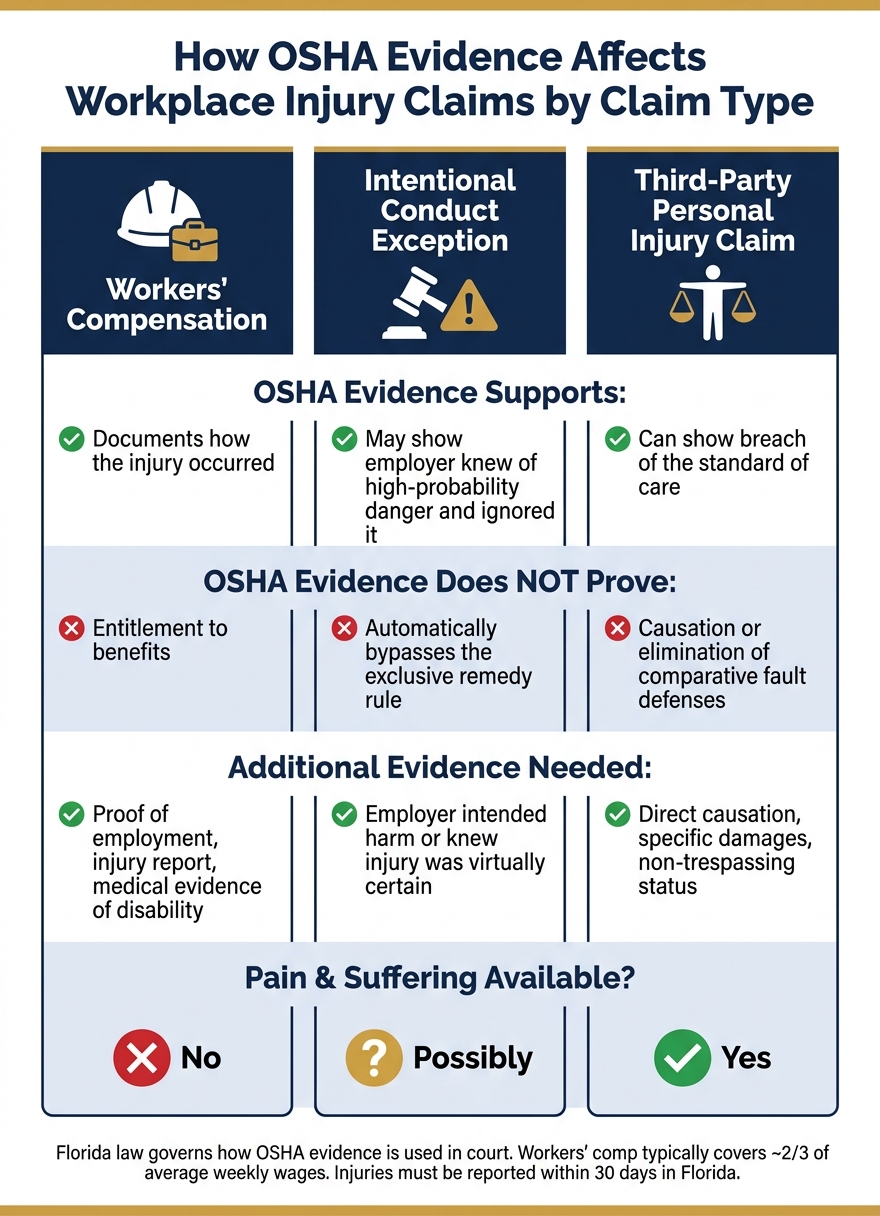
How OSHA Evidence Affects Workplace Injury Claims by Claim Type
OSHA evidence can help prove notice, breach, and causation. But it does not prove liability on its own. The big issue is whether that evidence ties the hazard to the injury.
Using OSHA Standards to Show the Standard of Care
Many courts treat an OSHA violation as evidence of negligence, not automatic proof of negligence. That matters because OSHA rules give courts a clear benchmark for what a reasonable employer should have done. If an employer broke that rule, it can be strong proof that the employer fell short.
At the same time, that doesn’t end the case. The claimant still has to prove causation. In plain English, it’s not enough to show a rule was broken. You also have to show that the broken rule had a direct link to the injury.
This point becomes even more important when no OSHA rule deals with the hazard at issue. That’s where OSHA’s General Duty Clause (29 U.S.C. § 654(a)) comes in. It covers gaps where no specific standard applies. To use it, a claim must show the hazard was known in the industry. Industry standards, such as ANSI guidelines, and manufacturer warnings can help prove that the danger was recognized.
How OSHA Findings Affect Workers’ Compensation and Third-Party Claims
An OSHA citation does not change workers’ compensation benefits. Still, in limited cases, it may help support a state-law exception to exclusivity. In those same limited situations, strong OSHA evidence may also help back a separate civil claim.
OSHA evidence can matter even more in third-party claims. If a general contractor, property owner, or equipment manufacturer helped create the unsafe condition, OSHA findings can help show that their equipment or site conditions played a part in the accident. That can open the door to a civil claim for damages that workers’ comp does not cover, including pain and suffering.
For example, in an Ocala warehouse case, OSHA used the General Duty Clause, industry standards, and the manufacturer’s warning to show that the forklift underride hazard was recognized and preventable. That’s why the inspection record can matter more than the citation itself. The paper trail often tells the stronger story.
Key Documents That Often Matter Most
The strongest claims usually hinge on records made before or during the inspection. In many cases, the best documents are the ones that show the hazard was there before the accident and that someone with authority knew about it, or should have known.
| Document | What It Can Show |
|---|---|
| OSHA inspection report | Inspector observations, measurements, and evaluation of the scene |
| Photographs from inspection | Physical conditions at the time of the accident |
| OSHA 300 injury logs | Workplace injury patterns |
| Training logs | Whether required safety training was actually completed |
| Abatement records | Whether the employer took corrective action after a citation |
| Internal safety communications | Recommendations or warnings management may have ignored |
| Manufacturer warnings | Evidence the employer was specifically warned about an equipment risk |
Internal warnings and abatement records often show whether management knew about the hazard and did anything about it.
Limits, Misunderstandings, and State-by-State Differences
What an OSHA Citation Does Not Automatically Prove
A lot of people assume that once OSHA issues a citation, the case is basically won. That’s not how it works.
An OSHA citation shows there was a safety violation. But it does not automatically prove liability, and it does not prove damages.
To win a claim, the injured person still has to show that the violation caused the injury. If that connection isn’t there, the claim can still fall apart even if a citation exists.
Florida comparative fault can also cut down damages if the worker partly caused the accident. An OSHA citation doesn’t wipe that away. It can still serve as useful evidence of the expected standard of care, but it doesn’t decide the case by itself.
Why State Law Changes the Outcome
This matters because the same OSHA citation can affect claims in very different ways from one state to another. OSHA is a federal program, but Florida law controls how OSHA violations are used in court.
Negligence law, workers’ compensation statutes, and evidence rules all help shape what a citation means in Ocala, Marion County, and across the rest of Florida.
Florida law controls how OSHA evidence is used, and workers’ compensation will usually still be the exclusive remedy against the employer.
How OSHA Evidence Applies Across Different Claim Types
The kind of claim you bring makes a big difference in how much an OSHA record helps. In some cases, it can support a key part of the argument. In others, it has a much smaller role.
| Claim Type | Supports | Does Not Prove | Additional Evidence Needed |
|---|---|---|---|
| Workers’ Compensation | May help document how the injury happened | Does not prove benefits | Proof of employment, an injury report, and medical evidence of disability |
| Intentional Conduct Exception | May help show the employer knew about a high-probability danger and ignored it | Does not automatically bypass the exclusive remedy rule | Evidence that the employer intended harm or knew injury was virtually certain to occur |
| Third-Party Personal Injury Claim | Can help show breach of the standard of care | Does not prove causation or eliminate comparative fault defenses | Proof of direct causation, specific damages, and that the injured party was not trespassing |
The claim type controls how much weight OSHA evidence carries. In a third-party personal injury case, it can be a strong piece of evidence. In a standard workers’ compensation claim, it usually matters much less.
Steps to Take After an OSHA-Related Workplace Injury
Protect the Evidence Early
OSHA evidence matters most when the scene stays intact before anything changes. Those first few hours can shape your claim in a big way.
Get medical attention right away. Your medical records help show when the injury happened and how serious it was. Then report the accident to your employer as soon as you can. In Florida, workers must report injuries within 30 days to keep workers’ compensation eligibility, but sooner is much better. Waiting gives the other side more room to question what happened.
Before anyone cleans up the area or repairs equipment, take photos and videos of the scene. Document the equipment, the floor, the signage, and the area around it. Keep the clothing or gear you were wearing. If a machine was involved, do not let it be serviced or removed until it has been documented. Also get the names and contact details of any witnesses who saw the accident or knew about the hazard.
From day one, hold on to every record you can:
- Discharge papers
- Medical bills
- Prescription receipts
- Records showing missed work
If chemical exposure played a part, ask for the Safety Data Sheet (SDS) for the substance. You should also request the employer’s OSHA injury log. Employers are legally required to keep these records, even though some push back when asked to share them.
Coordinate OSHA Issues With the Injury Claim
After the evidence is protected, the next problem is saying different things in different claims.
OSHA investigations can overlap with workers’ comp claims and third-party injury claims, so timing matters. Talk to a lawyer before giving statements or signing anything. A workers’ comp settlement can affect a separate injury case. Miss a filing deadline in one matter, and it can limit what you can still pursue in another.
A lawyer can look at OSHA citations and inspection findings alongside your workers’ compensation claim and any third-party options. That helps keep deadlines, evidence, and statements in line. Ocala Injury Law can review OSHA findings, workers’ comp issues, and possible third-party claims.
Conclusion: OSHA Violations Can Help, but the Claim Still Must Be Built Carefully
OSHA violations can make a workplace injury claim stronger, but only when the evidence is preserved and connected to the right legal theory. A citation by itself does not decide the case.
How much weight OSHA evidence carries depends on the type of claim, the proof behind it, and Florida law. It tends to matter most when it lines up with the right claim and the right state-law rules. The better the early record, the more use an OSHA violation may have in the claim.
If you or a family member were hurt in a workplace accident involving a potential OSHA violation, Ocala Injury Law can help review the OSHA findings, look at workers’ compensation issues, and see whether a personal injury claim may be available.
FAQs
Can I sue if OSHA cited my employer?
Usually, no. In Florida, workers’ compensation usually limits an employee to benefits and blocks lawsuits against an employer for a job-related injury.
An OSHA citation can help show that a safety rule was broken, but it does not automatically give you the right to sue. You may still have a civil claim if your employer did not carry the required workers’ compensation insurance, acted on purpose, or a third party caused the injury.
What OSHA records should I request first?
Start with your employer’s injury logs. They can show a pattern of workplace hazards or problems with how incidents were reported.
You should also ask for safety data sheets, maintenance records, and official incident reports. These records can help show whether the employer fell short of industry standards or OSHA rules.
Can I still recover if I was partly at fault?
It depends on the type of claim.
With workers’ compensation, the system is usually no-fault. That means you can often get benefits as long as the injury happened while you were doing work-related tasks. In plain English: you don’t have to prove your employer did something wrong to qualify.
A civil personal injury claim works differently. In Florida, comparative fault applies. So if you’re partly to blame for what happened, your damages are cut by your share of fault. On top of that, an employer may deny a workers’ compensation claim if it can show that you caused the injury or were acting outside your job duties when it happened.