
Yes – you can usually fire your personal injury lawyer, but one missed deadline can wreck your case. In the U.S., clients often have the right to end the relationship at any time. But if I do it the wrong way, I could face a fee dispute, lose access to my file, or miss a court date or statute of limitations.
Here’s the short version:
- I should read my fee agreement first to check notice rules, costs, liens, and file transfer terms.
- I need to know who is ending the relationship: client discharge and attorney withdrawal are not the same.
- I should send written notice with a clear end date and keep proof it was delivered.
- I should line up new counsel before ending the relationship so there is no gap in representation.
- I need my full case file fast, including medical records, pleadings, photos, discovery, and settlement communications.
- I should confirm all deadlines right away, especially the statute of limitations, court hearings, and insurance response dates.
- I need a final accounting for trust funds, costs, refunds, and any attorney lien tied to a future settlement.
- If a lawsuit is already filed, the court may need a Substitution of Counsel before the switch is complete.
A messy handoff can cost time and money. A clear written record, a fast file transfer, and prompt deadline checks can help me change lawyers without hurting my case.
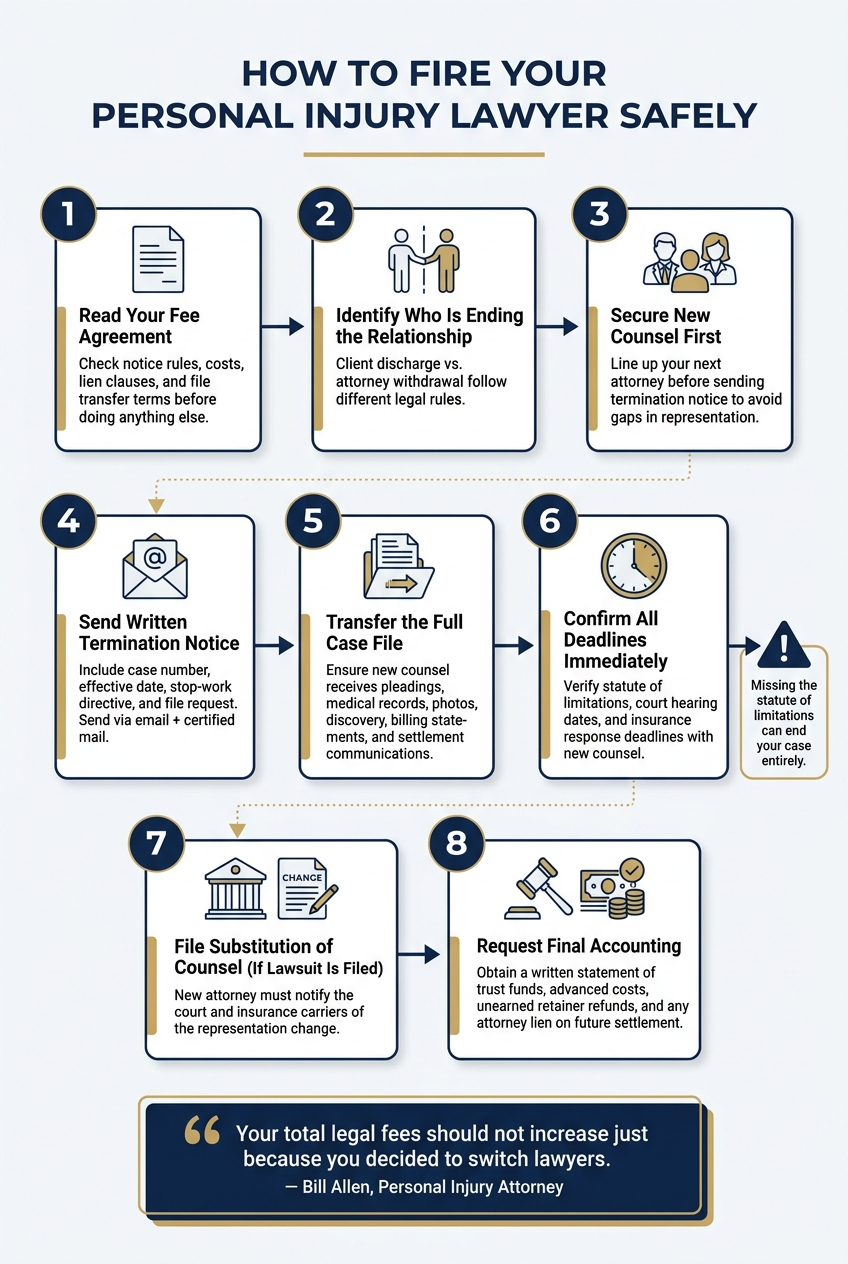
How to Fire Your Personal Injury Lawyer: 8-Step Safe Transition Guide
Start by Knowing Your Rights and Reading Your Fee Agreement
Before you end the relationship, read your fee agreement closely. That document sets the rules for notice, costs, and how your file moves to another lawyer. The aim is simple: end things cleanly, without delays, fee fights, or missed deadlines. As Bill Allen of Allen Law points out, the attorney works for you.
After that, figure out who is ending the relationship. That changes what happens next.
Client Discharge vs. Attorney Withdrawal
There’s an important difference between a client discharge and an attorney withdrawal. A client discharge means you end the relationship. An attorney withdrawal means the lawyer asks to step away from the case.
Both can happen, but they follow different rules. And that matters. It can affect who handles court filings, who tracks deadlines, and whether the court must be notified.
If your case is already in court, the change may need to be handled through a "Substitution of Counsel." The court may also need to approve the switch so the case doesn’t get held up.
Once you know who is ending the relationship, go back to the contract and check the rules on notice, costs, and file transfer.
Retainer Clauses That Affect Termination
Before you send notice, review your signed fee agreement and look for these sections:
- Termination procedure – Does the contract require written notice? Certified mail?
- Expense reimbursement – Are you responsible for out-of-pocket costs like filing fees, expert witness charges, or medical record retrieval that the firm already paid?
- Attorney lien language – Many contingency agreements let a discharged attorney place a lien on your later settlement for work already done.
- File release terms – You have a right to your file, but some agreements spell out how and when it will be transferred.
Some states and contracts also set short notice or rescission rules, so check your deadline before you send anything.
Then line up those contract terms with your fee setup, because the money side depends on how you were billed.
How Billing Structure Affects Your Fees at Termination
In contingency-fee cases, switching lawyers usually does not mean you pay more in total legal fees.
"Your total legal fees should not increase just because you decided to switch lawyers." – Bill Allen, Attorney, Allen Law
In many cases, the old lawyer and the new lawyer split the original agreed percentage based on the amount of work each one did. Where clients sometimes get caught off guard is case costs. If the first firm advanced expenses and hasn’t been paid back, that can still affect your recovery. So the issue isn’t only what you owe today. It’s also how to protect any money you may recover later.
| Fee Type | Likely Payment Issue at Termination | Refund Expectations | Records to Request |
|---|---|---|---|
| Contingency Fee | Former attorney may file a lien on your settlement for work performed | No upfront refund; old and new counsel split the agreed percentage | Detailed log of hours worked and list of advanced costs |
| Hourly Fee | You owe for all hours logged up to the moment of termination | Refund of any unearned retainer held in trust | Itemized billing statements and time-tracking logs |
| Flat Fee | Dispute may arise over how much of the work was completed | Pro-rated refund for unearned portions of the fee | Proof of completed work products or filings |
Knowing your fee type helps you see two things clearly: what you may still owe, and what money you may be able to get back.
sbb-itb-68ed374
End the Relationship in Writing and Keep Communication Clear
Once the fee agreement is settled, put your decision in writing so the end date is crystal clear. A written notice closes out the representation, creates a paper trail, and can help stop more billing. Keep the letter direct and factual.
You do not have to explain why you’re ending the relationship. A calm, matter-of-fact tone is the best way to protect the record.
What to Include in a Termination Letter
Your termination letter should include:
- Your full name and contact information
- The case reference or file number
- A clear statement that you are ending the representation
- The effective date
- A directive to stop work on your case immediately
- A request for your complete case file
- A request for all upcoming court dates and deadlines
"If you decide you would like to switch, write a letter directed at your lawyer and include a signature and date." – Carey Meldon, Managing Partner, Meldon Law
Email the letter first. Then mail a signed copy by certified mail, return receipt requested. That gives you proof the attorney got it, which matters if there’s ever a dispute about when the representation ended.
Keep a signed copy for your own records, along with the original fee agreement. That paper trail also makes it easier for the next lawyer to step in without missing deadlines.
Phone Call Plus Written Notice vs. Written Notice Only
If the issue came from a misunderstanding, or the attorney has already put in a lot of time, a short call before the letter may help cut down on confusion. If the relationship has been tense, written notice only is often the safer move.
Think of the call as a way to clear the air. Think of the letter as the part that creates the record.
Protect Your Personal Injury Case During the Transition
After you send written notice, switch at once to the file transfer and deadline check. This is the part where mistakes can hurt. The handoff window is fragile, and even a short gap in representation can damage your case.
Transfer the Full File and Confirm Key Deadlines
Your new lawyer should get the full file from prior counsel. That file should include pleadings, medical records, billing statements, photographs, discovery, insurance communications, and settlement offers.
If even one piece is missing, your new legal team may have to spend extra time and money rebuilding work that was already done.
"Your new attorney can usually handle getting your file transferred from your old attorney’s office." – Bill Allen, Attorney, Allen Law
It usually makes sense to let your new attorney contact the prior firm and handle the transfer directly. Once the file comes in, new counsel should check key dates right away, including the statute of limitations, any scheduled hearing dates, and any insurance response deadlines.
Miss the statute of limitations, and the case can be over.
When New Counsel Should Step In Quickly
If your case has a pending lawsuit, an approaching statute of limitations, scheduled court hearings, or active settlement negotiations, your new lawyer should step in as soon as possible.
When a lawsuit has already been filed, the switch does not happen only between law firms. The court has to be notified too. In that situation, new counsel must file a Substitution of Counsel and notify the clerk. The insurance companies tied to the claim should also get notice of the change.
Florida courts can deny a substitution if the change would slow the case down.
After the transfer is confirmed, wrap up fees and trust funds before moving to the next step.
Wrap Up Files, Money, and Confidentiality Before Moving On
After the handoff, take care of the money side and privacy details. That helps prevent delays, confusion, or a fee fight later.
Client Property, Trust Funds, and Unearned Fees
Ask your former attorney for a final accounting. You want a clear written statement that shows all costs paid so far, any client money still held in trust, and whether any unearned part of your retainer must be refunded.
The firms may split the contingency fee based on the work each one finished. Your former attorney may also be owed repayment for out-of-pocket costs paid for your case, such as expert witness fees or court filing fees. It also helps to review your original retainer agreement so you know what costs may still apply before the case closes.
Once the money piece is settled, confirm that any future contact stays limited to case-closing matters.
Confidentiality and Limited Follow-Up Contact
Your attorney’s duty to protect your confidential information does not stop when the representation ends. Confidentiality continues after the representation ends. Any follow-up contact should stay limited to file transfer, final accounting, or a fee issue.
Conclusion: Key Steps for a Safe and Smooth Transition
Ending an attorney-client relationship is a serious call, but it doesn’t have to put your case in danger. The main thing is to move with care at each step instead of reacting out of frustration.
Start by reviewing your fee agreement before you do anything else. Then send written notice and keep proof that it was delivered. That paper trail matters.
After notice goes out, shift straight to the handoff. Secure new counsel before you send notice. If there’s a gap in representation, it becomes much easier to miss a statute of limitations deadline or lose momentum in a filed lawsuit.
Once you change counsel, confirm how fees will be handled. Switching lawyers should not increase your total legal fees. If the lawyers can’t work it out, a court may set a reasonable fee for the work already done.
"Your total legal fees should not increase just because you decided to switch lawyers."
- Bill Allen, Personal Injury Attorney
When your new attorney is in place, they can handle the file transfer, file a Substitution of Counsel if a lawsuit has already been filed, and check every upcoming deadline.
A careful handoff helps protect both your case and your money.
FAQs
Can my lawyer refuse to release my file?
In Florida, you can fire your attorney at any time. Once you do, your lawyer must turn over your full case file, including documents, correspondence, evidence, and court filings.
If your attorney pushes back, the issue is often tied to the handoff process, such as bringing in substitute counsel or sorting out expenses. If you’re changing lawyers in the middle of a case, your new attorney can often get the file on your behalf.
What if I fire my lawyer right before a deadline?
Firing your attorney right before a deadline is risky, and you need to move fast to protect your case.
If you plan to switch, try to line up new counsel before you officially fire your current lawyer. If you don’t, you could miss court deadlines or the statute of limitations. And that can get your lawsuit dismissed.
Will I still owe money after switching lawyers?
Yes, you may still owe money, but your total legal fees usually should not go up.
Here’s the basic idea: in most personal injury cases, attorneys work on a contingency fee basis. That means you generally do not owe attorney’s fees if the case is unsuccessful.
That said, your former lawyer may still be paid for the work already done. In many cases, that payment comes through a split of the final contingency fee rather than an extra charge added on top.
You may also need to pay back out-of-pocket costs they advanced, such as:
- Filing fees
- Expert witness fees
So while switching lawyers can affect who gets paid, it usually doesn’t mean you’ll pay more in total attorney’s fees.