
Your injury claim is usually worth more when the injury lasts longer, costs more to treat, cuts into your work, and changes daily life in a lasting way. But even then, fault rules and insurance limits can cut the final payout hard.
If I had to boil this article down to the main point, it would be this:
- Medical bills matter
- Pain and life disruption matter
- Proof matters
- Fault matters
- Insurance limits matter
A small strain with a few doctor visits will not be valued like a spinal injury, brain injury, burn, or surgery case. The difference often comes down to things like future care, missed income, permanent limits, and whether the records clearly connect the injury to the accident.
A few numbers show why this matters:
- CDC data in the article puts the 1-year average medical cost at about $5,800 for ER-treated nonfatal injuries
- That number jumps to about $52,250 for inpatient cases
- In Florida, if you are more than 50% at fault, you recover $0
- A $25,000 bodily injury policy can cap what you collect, even if your losses are much higher
- Many Florida negligence claims must be filed within 2 years
Quick overview
Here are the 10 things that most often shape settlement value:
- Severity and type of injury
- Amount of medical treatment
- Future medical needs
- Lost wages during recovery
- Reduced earning capacity
- Pain and suffering
- Permanent disability or impairment
- Scarring and disfigurement
- Pre-existing conditions made worse
- Liability, comparative fault, and insurance limits
sbb-itb-68ed374
Quick Comparison
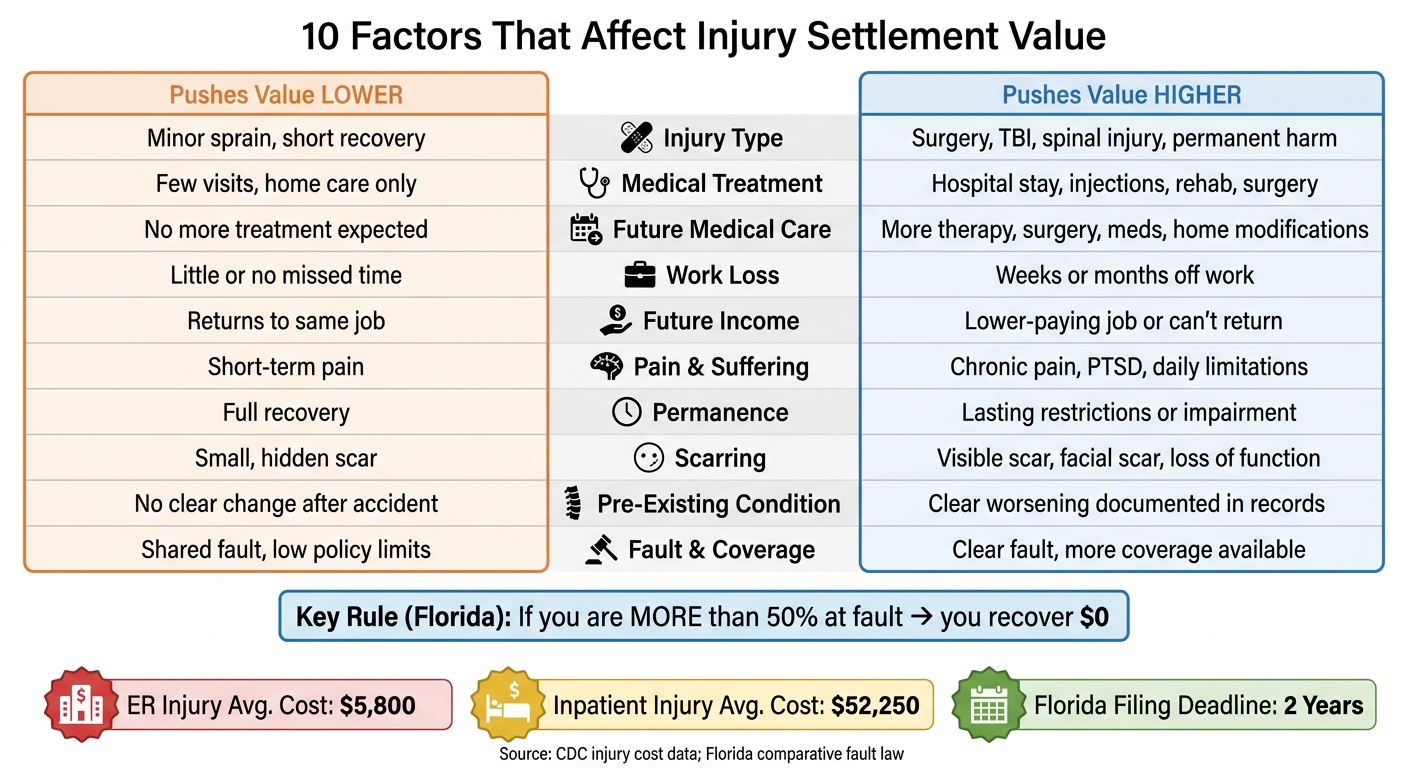
10 Factors That Affect Injury Settlement Value: Low vs. High
| Factor | Usually pushes value lower | Usually pushes value higher |
|---|---|---|
| Injury type | Minor sprain, short recovery | Surgery, TBI, spinal injury, permanent harm |
| Treatment | Few visits, home care only | Hospital stay, injections, rehab, surgery |
| Future care | No more treatment expected | More therapy, surgery, meds, home changes |
| Work loss | Little or no missed time | Weeks or months off work |
| Future income | Back to same job | Lower-paying job or can’t return |
| Pain and suffering | Short-term pain | Chronic pain, PTSD, daily limits |
| Permanence | Full recovery | Lasting restrictions or impairment |
| Scarring | Small, hidden scar | Visible scar, facial scar, function loss |
| Pre-existing condition | No clear change after accident | Clear worsening shown in records |
| Fault and coverage | Shared fault, low limits | Clear fault, more coverage available |
In short: settlement value is tied to how bad the injury is, how long it lasts, how well it is documented, and whether there is money available to pay the claim.
Why the Nature of an Injury Affects Settlement Value
Settlement value shifts based on how serious the injury is, how long recovery takes, and what kind of care the person needs.
A cervical disc herniation, for example, can mean MRI scans, specialist visits, injections, possible surgery, and months of physical therapy. That’s a very different picture from a minor strain. And insurers and attorneys don’t treat those injuries as equal.
Objective medical findings matter a lot here. MRI results that show a herniated disc or torn ligament, X-rays that confirm a fracture, surgical records, and specialist evaluations all help turn a person’s symptoms into proof on paper. In many cases, insurers and lawyers look at injury severity as one of the main drivers of settlement value, not just the damage to the car.
Doctor-imposed restrictions can matter too. If a doctor says a patient can’t lift past a certain weight, can’t sit for long periods, or shouldn’t drive, that ties the injury to lost income and day-to-day limits. That can push settlement value higher.
Here’s a quick look at how injury severity and treatment often line up:
| Injury Type | Typical Treatment Path | Settlement Tier |
|---|---|---|
| Minor sprain or strain | Rest, over-the-counter medication, 1–3 follow-up visits | Low |
| Fracture (non-surgical) | ER visit, imaging, casting, orthopedic follow-up | Moderate |
| Herniated disc with injections | MRI, specialist care, injections, physical therapy | Moderate to High |
| Surgical injury or fracture | Surgery, hospitalization, rehabilitation, specialist care | High |
| Traumatic brain injury (TBI) | Neurologist, neuropsychological testing, long-term monitoring | High to Severe |
| Permanent disability or spinal cord injury | Lifelong care, adaptive equipment, lost earning capacity | Severe |
A longer recovery often means more medical visits, more records, and more disruption to daily life. And that usually starts with the type and severity of the injury.
1. Severity and Type of Physical Injury
The more serious the injury, the more it tends to push a settlement upward. That usually starts with medical bills, but it doesn’t stop there. Recovery takes longer, work gets interrupted, and day-to-day life can change in ways that are hard to ignore.
Economic Damages
A non-surgical fracture might mean an ER visit, imaging, and a handful of orthopedic follow-ups. A spinal cord injury is a different story. It can involve surgery, a hospital stay, long rehab, assistive devices, and changes to the home itself.
Lost wages often follow that same pattern. Missing two weeks of work is one thing. Being unable to return for months, or longer, is a much bigger financial hit.
And as bills go up, so does the personal toll.
Non-Economic Damages
Pain and suffering, emotional distress, and loss of enjoyment of life are closely tied to how serious the injury is and how long it lasts. Catastrophic injuries like paralysis, amputation, and severe burns often lead to the highest non-economic awards because they can permanently change how a person lives.
Strength of Medical Proof
Strong medical proof can make a big difference. MRI scans, surgical records, and specialist reports make severe injuries easier to show and harder for the other side to argue away.
Long-Term Impact on Daily Life and Work
This is often where severe injuries add the most to settlement value. If someone has lasting physical limits that affect their job, routine tasks, or basic independence, that can support a much higher damages claim during settlement talks.
2. Extent of Medical Treatment
The amount of medical care you need has a direct effect on what your claim may be worth. A case that involves surgery, months of physical therapy, and follow-up visits with specialists is in a very different spot than one with only a handful of appointments. And when treatment goes on long enough to show that more care may be needed later, that can push the value higher.
Economic Damages
Medical bills are usually the clearest out-of-pocket loss in an injury claim. According to CDC data, the one-year average medical cost for nonfatal injuries is about $5,800 for emergency department cases and about $52,250 for inpatient cases.
Care such as orthopedic surgery, epidural steroid injections, or inpatient rehabilitation can be expensive. Those costs often set the tone in settlement talks. Insurers and attorneys usually look at medical expenses as a concrete starting point when putting a dollar figure on a claim.
Non-Economic Damages
Longer and more intensive treatment can show how serious an injury was in day-to-day life, not just on paper. If someone goes to physical therapy three times a week for several months, or has more than one surgery, that tends to support a stronger pain-and-suffering claim than a case where treatment ends after a few weeks.
Insurers often look at medical bills and recovery time as reference points for pain-and-suffering claims, often by comparing medical costs and how long recovery lasted.
Strength of Medical Proof
Steady treatment records can help connect the accident to the injury and show how serious the injury was. Gaps in care or long delays before getting treatment can give insurers room to argue about both the cause of the complaints and how bad they were. Those records can also show whether treatment is likely to continue.
Long-Term Effect on Daily Life and Work
Frequent appointments and recovery time can cut into work hours and make normal daily tasks harder. When treating physicians note specific limits – like no lifting over 10 pounds or staying off work for four weeks – those records can support claims for lost wages and limits on daily activity. In plain terms, longer treatment usually means a longer disruption, which can increase both economic and non-economic damages.
If treatment continues past the expected recovery period, settlement value often goes up again.
3. Future Medical Needs
When treatment will continue after a settlement, projected care becomes part of the case value. Past medical bills are fixed and easy to show with records. Future medical needs are different. They have to be estimated from medical evidence because they cover costs the injured person may face after the case ends.
Economic Damages
Future medical expenses fall under economic damages because they reflect actual out-of-pocket costs a person may have to pay later.
These costs can include:
- Doctor visits
- Specialist follow-ups
- Recommended surgeries
- Physical therapy
- Rehabilitation
- Prescription medications
- Assistive devices such as wheelchairs or braces
- Home or vehicle changes such as ramps, lifts, or hand controls
In serious injury cases, attorneys and medical experts often use a life care plan. This plan maps out the services the person is expected to need, how often those services will be needed, and how long the care is likely to last.
Non-Economic Damages
Future medical needs also shape non-economic damages because they show how long the injury may keep affecting daily life. Years of therapy, repeat procedures, or chronic pain can support higher pain and suffering damages. Long-term care can also support a higher pain and suffering claim by showing that the disruption is not short-lived.
Strength of Medical Proof
Courts usually require future medical expenses to be reasonably certain to happen. That means a guess isn’t enough.
Strong proof often comes from:
- Treating physicians
- Medical records
- A life care plan prepared by a qualified expert, such as a rehabilitation specialist or nurse
Future expenses need support from medical opinions and a life care plan showing that the care is reasonably certain. That proof helps turn projected treatment into a dollar figure instead of a rough estimate.
Long-Term Effect on Daily Life and Work
Ongoing treatment can change a person’s routine in a big way. Regular appointments and the effects of future procedures may make it harder to handle household tasks, care for family, or stay independent. Even normal day-to-day activities can become tougher to keep up with.
When medical records and physician opinions tie those future medical needs to daily limits, the settlement demand often becomes much stronger.
4. Lost Wages During Recovery
If an injury forces someone to miss work, the settlement amount usually goes up with the income they lost during recovery. That can include missed hourly pay, salary, overtime, commissions, tips, and documented job benefits.
Economic Damages
Insurers and courts usually look at three basic points: what the person earned, how much work they missed, and whether medical restrictions caused that missed time.
To prove those points, records matter. Pay stubs, W-2s, tax returns, and employer verification letters can help show lost income. If the injured person is self-employed, they’ll usually need business records such as profit-and-loss statements, invoices, and bank records.
Non-Economic Damages
Missing work can also help show how much the injury disrupted daily life. Being away from a job for weeks or months can bring anxiety, break a person’s routine, and add emotional strain. That kind of disruption can support a higher pain and suffering claim.
Strength of Medical Proof
Clear medical restrictions make this part of the claim much stronger. A physician’s note stating the patient cannot stand for more than 2 hours and is off work entirely from 03/01/2026–04/15/2026 is much harder for an insurer to challenge than a vague note about discomfort.
Long-Term Effect on Daily Life and Work
A short absence and a long recovery do not affect claim value in the same way. Reduced hours or light duty can support both wage loss and the seriousness of the injury. It shows the person tried to keep working but couldn’t handle full duties, and the medical records back that up.
Lost wages deal with temporary income loss. The next issue is whether the injury affects future earning capacity.
5. Reduced Earning Capacity
Reduced earning capacity is about future income loss, not paychecks you already missed. The core question is simple: what will this person be able to earn going forward, compared with what they likely would have earned without the injury? This issue matters most when an injury changes someone’s work life long after the healing period ends.
Economic Damages
When a person has to move into lower-paying work for good, the future wage gap can add up fast, especially if it lasts for years. To estimate that loss, vocational experts and economists often look at wage records, tax returns, and labor data. Those opinions tend to carry more weight when they line up with medical proof and clear work restrictions.
Non-Economic Damages
A forced career change can hit more than a paycheck. It can bring stress, a loss of identity, and a lower quality of life. That can support higher non-economic damages because it shows the injury affects both earning power and day-to-day life.
Strength of Medical Proof
Medical records need to connect the injury to lasting work limits, such as limits on lifting, standing, or the number of hours a person can work. An FCE can add objective support.
Long-Term Effect on Daily Life and Work
Many injured people end up moving to part-time schedules, losing overtime, missing promotions, or taking jobs that don’t fit their skills. A before-and-after work history can help make that change clear. Employer statements and performance reviews can also help show the shift is permanent, not short-term.
Reduced earning capacity often carries the most weight when the records show the job change is permanent or at least long term. The next issue is how records prove those limits.
6. Pain and Suffering
Pain and suffering tends to go up when an injury is severe, lasts a long time, or doesn’t heal cleanly. This part of a claim covers losses that don’t come with a receipt – chronic physical pain, anxiety, depression, PTSD, sleep problems, and the loss of normal day-to-day activities like parenting, exercise, or even getting through the workday with focus intact.
Some injuries usually support stronger claims here. Fractures, nerve damage, burns, and surgery often lead to higher pain and suffering because they can cause deeper pain that lingers.
Non-Economic Damages
Pain and suffering falls under non-economic damages. In Florida, standard civil jury instructions list pain and suffering, disability or physical impairment, disfigurement, mental anguish, inconvenience, and loss of enjoyment of life as harm a person can recover for.
There isn’t a set formula for putting a dollar amount on it. Juries are told the amount should be "fair and just in the light of the evidence." That matters because insurers usually try to frame value around a few practical points: how bad the injury was, how long recovery took, and how much the injury changed daily life. When pain is severe and lasts longer, the non-economic side of the claim usually goes up.
Strength of Medical Proof
Pain is personal, so medical records do a lot of the heavy lifting. Treatment notes that track pain scores at each visit, imaging that confirms the injury, mental health records showing anxiety or PTSD, and prescriptions for pain medication, muscle relaxers, or antidepressants can all help show that the suffering is real and still happening.
On the flip side, weak or uneven records can hurt this part of the claim. If the chart is inconsistent or there are gaps in treatment, insurers often push back hard. They may argue the pain wasn’t serious, didn’t last, or wasn’t tied to the injury at all. Strong records tell a cleaner story: the pain wasn’t brief, and it affected the person’s life in a steady way.
Long-Term Effect on Daily Life and Work
Pain and suffering usually carries more settlement weight when it continues long after the acute recovery period ends. There’s a big difference between someone who fully recovered in six weeks and someone who still can’t sleep through the night, go to family events, or stay focused at work because of daily pain.
When pain lasts beyond the expected recovery timeline, non-economic damages often climb. And when that pain leads to lasting limits in how a person lives or works, the claim starts moving into the next issue: permanent disability or impairment.
7. Permanent Disability or Impairment
Once an injury stops being temporary, the settlement picture changes. It’s no longer just about getting through treatment and healing. It becomes about living with a lasting loss.
When an injury leads to permanent loss of function, settlement value often goes up fast. A permanent disability or impairment usually means an ongoing loss of function, range of motion, or the ability to work or handle daily tasks. That can include lasting loss of function or chronic neurologic symptoms that are not likely to fully go away with treatment. In most cases, permanence is documented after the injured person reaches maximum medical improvement (MMI). That means no major recovery is expected going forward.
Economic Damages
Permanent impairment can push economic damages much higher because it often brings long-term or lifetime costs. That may include lifetime treatment, adaptive equipment, and lost future earning capacity.
If the injury keeps someone from going back to their old job, or forces them into lower-paying work, economists can calculate the present value of that lost earning capacity over the person’s remaining work-life expectancy. That number can be a big part of the claim.
Non-Economic Damages
Non-economic damages tend to carry more weight here than they do in temporary injury cases. The reason is simple: the harm doesn’t end.
Permanent injury can increase damages for pain, loss of normal movement, and the day-to-day toll of living with limits. When those harms last for life, a jury or claims adjuster may account for years of future loss, not just pain that has already happened.
Strength of Medical Proof
Permanence has to be backed up with solid, objective proof. Strong medical support often includes:
- Final treating physician reports confirming MMI and permanent restrictions
- Impairment ratings under the AMA Guides
- Diagnostic tests such as MRI, CT, EMG, or X-rays showing structural or neurologic damage
- Specialist opinions
- Functional capacity evaluations (FCEs) that measure what the person can and cannot do
Long-Term Effect on Daily Life and Work
Daily limits matter just as much as medical records. A permanent impairment can affect basic tasks like dressing, driving, cooking, childcare, and sleep. Those day-to-day losses help show what the injury has actually changed.
At work, the impact may show up as reduced hours, a move to lighter duties, or total job loss. If the injury also leaves visible marks, the next factor is scarring and disfigurement.
8. Scarring and Disfigurement
When an injury leaves a lasting visible mark, the case is no longer just about healing. It’s also about how that injury changes a person’s appearance, self-image, and day-to-day life.
Economic Damages
Scarring often leads to ongoing care that goes beyond the first round of treatment. That can include plastic or reconstructive surgery, dermatology visits, and other scar-focused care.
For people in customer-facing work, a visible scar can also affect income. That may matter in jobs such as:
- Sales
- Hospitality
- Media
- Customer service
In those roles, appearance can influence hiring, performance, and promotion, which may reduce earning capacity.
Non-Economic Damages
Florida’s standard civil jury instructions list disfigurement alongside disability and loss of enjoyment of life as parts of personal injury damages. There isn’t a fixed formula. Juries look at the proof and decide what weight to give it.
The scar’s location and visibility usually matter most. A clear facial scar on a young plaintiff will often carry more weight than a small scar that can be covered easily and has little social or emotional effect. If the person also has documented psychological harm, such as anxiety or social withdrawal, those damages may go higher. That effect tends to be strongest when the scar is obvious, permanent, and hard to hide.
Strength of Medical Proof
To show permanence, the file needs strong medical proof. That usually includes dated photographs showing how the scar changed from the time of injury through healing, along with surgical records, wound care records, and specialist opinions saying the scar is not likely to improve much more.
Those medical experts can also help with two key points:
- What future procedures may cost
- How much improvement is realistically possible
Long-Term Effect on Daily Life and Work
Scar tissue over joints can limit movement and affect function. A scar isn’t always just cosmetic. In some cases, it changes how a person bends, reaches, walks, or uses a hand or arm.
Visible scarring can also hurt confidence in ways that spill into work and daily routines. That can show up in job performance, interviews, public interaction, or career growth. The best proof often comes from personal journals, statements from family members, and psychological records.
Next, the issue shifts to whether a pre-existing condition made the injury appear worse or slowed recovery.
9. Pre-Existing Conditions and Aggravation
A pre-existing injury or health condition does not stop someone from recovering damages. If a crash or fall made that condition worse, or set it off in a new way, the defendant can be on the hook for that added harm. Under the eggshell plaintiff rule, which Florida follows along with courts across the U.S., a defendant takes the injured person as they find them. So if the person was more fragile than average, that does not let the defendant off the hook.
The key settlement issue isn’t whether the condition existed before the accident. It’s how much worse the accident made it.
Economic Damages
When an accident worsens a pre-existing condition, it can lead to care the person otherwise would not have needed. Take someone with degenerative disc disease. Before the incident, they may have been getting by. After the incident, they may need imaging, pain management, or even surgery because the accident pushed the condition into a worse state.
That added care can count as economic damages. The same goes for lost income. If recovery takes longer because of the aggravation, wage-loss claims can grow too.
Non-Economic Damages
Here, the focus is the gap between the person’s before and after. Medical records and testimony help show that shift. A person with arthritis may have been able to handle daily life before the incident. Afterward, basic movement may require help or come with severe discomfort.
That change matters. It’s the kind of loss non-economic damages are meant to address.
Strength of Medical Proof
Aggravation cases usually turn on medical proof. The usual building blocks are:
- Pre-accident records
- Post-accident records
- A doctor’s opinion tying the worsening to the incident
In Florida, that link is usually shown by more likely than not. Florida Standard Jury Instruction 501.5(a) also recognizes the aggravation or activation of a disease or defect. It tells juries to separate the prior condition from the accident-related worsening when they can. If they can’t reasonably split the two, they may award damages for the entire condition.
Even then, there’s a catch: strong medical proof does not set the payout by itself. Fault and insurance limits still shape the final number.
Long-Term Effect on Daily Life and Work
A worsened condition can shrink a person’s work options in ways the earlier condition never did. For example, someone with past back pain may suffer new disc herniations after a collision and no longer be able to lift, bend, or stand for long stretches. That can force a move to lower-paying work, fewer hours, or both.
Medical records, job records, and day-to-day personal records can help show the size of that decline. They paint the picture of what changed, and how much the accident added to the person’s limits.
10. Liability, Comparative Fault, and Insurance Limits
Even a severe injury doesn’t lead to a big settlement on its own. Fault and available insurance often control the outcome. If liability is weak or policy limits are low, recovery can hit a ceiling even in a serious injury case.
Economic Damages
When liability is clear, economic damages carry more weight in settlement talks. If fault is admitted or obvious, insurers are more likely to pay the full amount of medical bills, lost wages, and rehabilitation costs.
Florida’s modified comparative negligence rule also matters here. If a claimant is more than 50% at fault, that person recovers nothing. And even when damages are high, low policy limits can cap recovery unless other coverage is available.
Non-Economic Damages
Pain-and-suffering claims are easier for insurers to cut down when liability is disputed. If they can say the claimant helped cause the accident, they usually discount those damages.
On the other hand, when liability is strong and the medical record consistently shows functional limits and emotional distress, non-economic damages become much harder to brush aside.
Strength of Medical Proof
If fault is in question, the medical record has to do more than show treatment. It needs to connect the injury to the crash and lay out a steady symptom timeline.
Florida also looks at amounts paid or owed, not just billed charges. That point can make a big difference when damages are being counted.
Long-Term Effect on Daily Life and Work
Long-term harm can add a lot to a claim, but only when liability and coverage allow for recovery. Chronic pain, reduced work hours, or a permanent job change can increase case value. Still, that only helps if there is enough coverage in play.
Without UM/UIM or other available coverage, those long-term losses may go largely uncompensated.
That is why proof of fault and proof of coverage matter just as much as medical evidence.
How Documentation Supports Each Factor
Those factors matter only when the file proves them. Every part of a claim runs on proof. Strong records make serious injuries easier to price. Weak records do the opposite. Put simply, the quality of your records can push settlement value up or drag it down.
Medical records, imaging, and physician opinions show what happened, how bad the injury is, and what treatment may still be ahead. When a treating physician clearly ties the diagnosis to the accident by noting how the injury happened and whether the condition is permanent, it becomes much harder for an insurer to deny causation or pin the problem on a prior condition. Gaps in treatment give insurers room to argue that the injury was minor or unrelated.
After the injury is documented, the next issue is financial impact. Pay stubs, tax returns, employer letters, and disability records turn missed work into documented wage loss. Vocational assessments help prove reduced earning capacity by matching physical limits to job demands.
Current wage records help, but permanent limits often call for more. Impairment ratings and life-care plans can support larger settlement demands for permanent injury and future care. They turn long-term harm into measurable future loss.
Proof of damages matters, but liability proof still shapes what can be recovered. Accident reports, photographs, and witness statements show how the incident happened and who was at fault. These records can also help show whether the injury is temporary or permanent.
Temporary Injuries vs. Long-Term or Permanent Injuries: A Side-by-Side Look
This comparison shows why a short recovery often leads to a smaller claim than an injury that affects work, care, and daily life for the long haul.
At first, an injury is usually treated as temporary. That can change at maximum medical improvement (MMI), which is the point when doctors expect little or no more healing.
Here’s how temporary injuries and long-term or permanent injuries tend to affect damages:
| Damage Category | Temporary Injuries | Long-Term or Permanent Injuries |
|---|---|---|
| Treatment Duration | Weeks to a few months; often conservative care such as physical therapy or short-term medication | Months to years; may involve surgery, specialist visits, rehabilitation, and ongoing treatment |
| Future Medical Expenses | Minimal to none; the claim usually focuses on medical bills through recovery | Significant; may include future surgeries, therapy, medications, and assistive devices |
| Missed Work | Brief absence, reduced hours, or modified duties for days or weeks | Extended time away, repeated absences for treatment, or inability to return to the same role |
| Reduced Earning Capacity | Rarely applies; the person typically returns to the same job and income level | Often applies; lasting limitations may prevent a return to prior work or the same income level |
| Pain and Suffering | Limited to the recovery period and usually decreases as healing progresses | Longer-lasting and often higher |
| Daily Life Impact | Temporary disruption to driving, sleep, household chores, or exercise | Long-term limits on normal activities |
| Settlement Implications | Fewer damage categories; mainly past medical costs and short-term lost wages | Multiple overlapping damage categories; both past and future losses may be included |
Put simply, a short-term back strain and a permanent spinal injury don’t get valued the same way. One may heal with rest, therapy, and a short break from work. The other can affect income, medical care, and everyday tasks for years.
That gap matters even more when the law asks for proof that the harm will last. In Florida motor vehicle cases, non-economic damages usually require proof of a significant, permanent injury.
Florida and U.S. Legal Factors That Can Affect Settlement Value
A serious injury, even one with strong medical records, doesn’t always lead to full payment. Fault, insurance coverage, and filing deadlines can cut a claim down or wipe it out altogether. That’s why these rules matter so much. The injury may set the starting point, but Florida law often decides how much money is still on the table.
Florida follows modified comparative fault. If you’re more than 50% at fault, you get nothing. If you’re 50% or less at fault, your recovery is reduced by your share of fault. Say a jury awards $100,000 but decides you were 30% at fault. Your recovery drops to $70,000. That’s a big hit. And it helps explain why insurance companies argue over fault so hard – every point can mean less money paid.
Insurance limits can also put a ceiling on what you can collect. Florida does not require bodily injury coverage, so some policies carry very low limits. In that situation, UM/UIM coverage can become a major part of the case.
Timing matters too. In many cases, it matters just as much as fault and coverage. Many Florida negligence claims must be filed within two years, though some claims follow different rules. Miss the deadline, and even a strong case can fall apart.
Florida also generally does not place a fixed cap on pain-and-suffering damages in ordinary personal injury cases.
Put together, these rules often shape the actual settlement range far more than people expect.
Conclusion
Settlement value usually goes up when an injury is serious, long-lasting, well-documented, and disruptive to both work and daily life. In Florida, the final payout also depends on comparative fault rules, insurance policy limits, and filing deadlines. Those rules can shape the number just as much as the injury itself.
That’s why documentation matters so much. Medical records, imaging, doctor notes, and wage records help turn pain and disruption into damages that can be counted. Without that paper trail, even a serious injury may be valued too low.
To help protect claim value, get medical care as soon as you can, stick with treatment, and keep every bill, prescription, work note, and symptom log. If your injury is serious or the offer feels too low, Ocala Injury Law offers free consultations and individualized help evaluating claim value.
FAQs
How is pain and suffering valued?
Pain and suffering are non-economic damages. They cover personal harm that’s hard to put a dollar amount on, like emotional distress and loss of enjoyment of life.
Because these losses are subjective, legal teams may use a daily recovery journal and medical expert evaluations of functional limitations to document what the injured person is going through and support fair compensation.
What evidence helps prove my claim?
To prove a personal injury claim, you need objective evidence that shows three things: liability, causation, and damages.
That usually starts with the basics: medical records, incident reports, photos of the scene or any hazardous conditions, and witness statements. These pieces help show what happened, who may be at fault, and how the injury connects to the incident.
Expert testimony can also play a big part. An expert may explain the cause of the injuries, what accepted industry standards required in that situation, and what future medical care may cost or involve.
A daily recovery journal can help too. It gives a day-by-day picture of how the injuries affect your routine, pain levels, sleep, work, and other parts of everyday life.
Can I recover if I had a prior injury?
Yes. A prior injury doesn’t automatically stop you from seeking compensation.
What matters most is showing a clear link between the new incident and the harm you’re dealing with now. In many cases, medical experts can help sort out what came from your earlier condition and what was caused by the recent accident.
Ocala Injury Law offers personalized support to help protect your rights.