
If you get hurt at work, the law can help in more than one way. In most cases, you may have rights to medical care, part of your lost pay, a safer workplace, protection from punishment for reporting the injury, and leave or job changes while you recover.
Here’s the short version:
- Workers’ compensation usually pays for treatment and part of lost wages
- OSHA requires employers to deal with known job hazards
- Anti-retaliation laws can protect you if you report an injury or file a claim
- FMLA may give you up to 12 weeks of unpaid, job-protected leave
- ADA may require job changes or work limits when you return
A few facts matter right away. Workplace injury rules are not the same in every state. For example, in Florida, workers usually have 30 days to report a job injury. Workers’ comp is also often a no-fault system, which means I don’t usually have to prove my employer caused the injury to seek benefits.
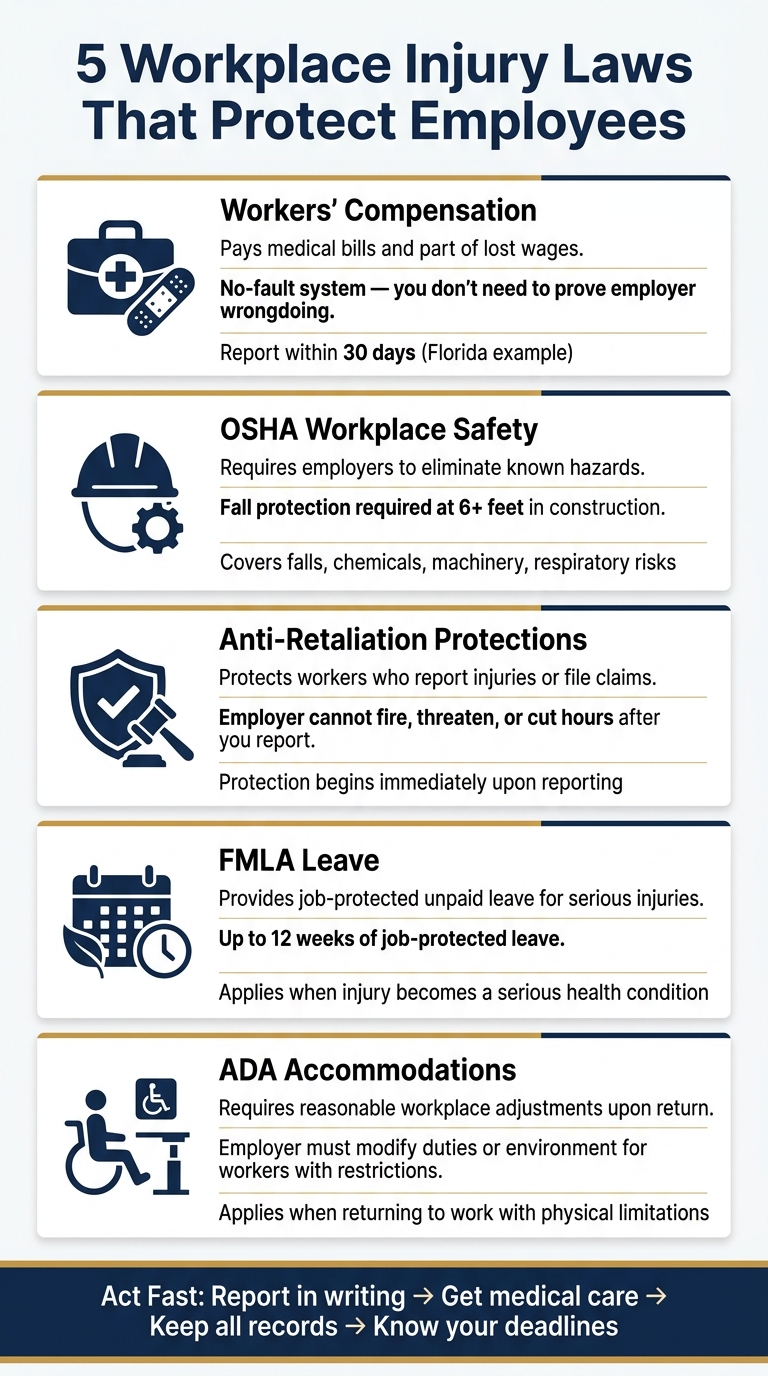
5 Workplace Injury Laws That Protect Employees: Quick Reference Guide
Quick Comparison
| Protection | What it does | When it usually helps |
|---|---|---|
| Workers’ compensation | Pays medical bills and part of lost wages | After a work injury or work-related illness |
| OSHA | Sets job safety rules | Before and after a hazard is found |
| Anti-retaliation laws | Block punishment for reporting injuries or filing claims | After I speak up or seek care |
| FMLA | Gives unpaid, job-protected leave | When an injury becomes a serious health condition |
| ADA | May require reasonable job changes | When I return to work with limits |
Bottom line: if I’m hurt on the job, I should report it in writing, get medical care, keep records, and act fast on deadlines. This article explains the five main legal protections in simple terms.
sbb-itb-68ed374
What Workplace Injury Laws Cover
Workplace injury laws apply to both sudden accidents and harm that builds up over time. That can mean a fall from scaffolding, a machinery malfunction, repetitive stress injuries, toxic exposure, burns, and work-related illnesses such as respiratory disease or cancer. That basic coverage sets up the worker protections explained below.
Workers’ compensation is usually a no-fault system. In plain English, you don’t have to prove your employer did something wrong to get benefits. If the injury happened while you were working, traveling for work, or attending a work meeting, you’re generally covered.
Your coverage can change based on your job status and the law in your state. In Florida, for example, construction employers must cover every worker. Most other private employers only need coverage if they have four or more employees. Independent contractors are often left out, but misclassification matters here. If someone is labeled an independent contractor but works like an employee, they may still have a valid claim.
Timing matters a lot. In Florida, you generally have 30 days to report an accident to your employer. The next section explains workers’ compensation benefits in detail.
1. Workers’ Compensation Benefits
Workers’ compensation pays for medical care and part of your lost wages after a job-related injury. But there’s a catch: it’s usually the exclusive remedy. That means you can’t also take your employer to civil court for pain and suffering in most cases. Once you file a claim, workers’ comp steps in to help with treatment costs and missed paychecks.
When It Applies
Workers’ comp usually applies when you’re hurt while doing your job. That can include work duties, work travel, and business meetings. It usually does not cover a normal commute or injuries tied to personal activities.
There are also some common exclusions. For example, workers’ comp does not apply to injuries caused by intoxication or horseplay.
What Employee Rights It Provides
Workers’ comp covers more than a single doctor’s appointment. It can pay for care now, care later, and income support if you can’t work.
| Benefit Category | What It Covers |
|---|---|
| Medical Benefits | All necessary treatment for the work-related injury, including future care |
| Temporary Disability | A percentage of your average weekly wages while you’re unable to work |
| Permanent Total Disability | Long-term wage replacement for catastrophic injuries like paralysis or brain damage |
| Vocational Rehabilitation | Job training and counseling if you can’t return to your previous role |
| Death Benefits | Funeral expenses and financial support for surviving family members |
In most cases, medical bills are sent to the employer’s insurer, not to you.
Those rights can hinge on timing. Miss a deadline, and things can get messy fast.
Common Limits or Deadlines
Reporting and filing deadlines change from state to state, so act right away after an injury. The timing of benefits and limits on wage replacement also depend on state law.
Workers’ compensation deals with the injury after it happens. OSHA standards are about stopping the next one.
2. OSHA Workplace Safety Standards
OSHA sets the baseline safety rules meant to stop preventable injuries at work. Employers aren’t free to treat those rules as suggestions. They have a legal duty to follow them.
Most of these rules focus on the hazards workers run into all the time, like falls, chemical exposure, machine risks, and breathing hazards.
Type of Legal Protection
OSHA gives employees the right to work in a place free from known hazards. That means employers must look for dangers, fix them, and provide the safety gear workers need to do the job with less risk.
That can include guardrails for people working at heights, respirators for workers exposed to dust or fumes, and proper lockout/tagout (LOTO) steps to shut down machinery before maintenance starts. Employers also have to train workers on hazardous chemicals. That includes access to safety data sheets and proper labeling.
If a worker spots an unsafe condition, they can report it and ask for an OSHA review.
When It Applies
OSHA standards apply when certain hazards are on the job. Think falls, hazardous chemicals, machinery, or respiratory risks.
In construction, fall protection is required at 6 feet or more. Employers who handle hazardous materials or run machinery must follow the standards tied to those risks. And that matters for a simple reason: one missed safety step can turn an ordinary workday into a bad injury.
What It Protects
| OSHA Standard | What It Requires |
|---|---|
| Fall Protection | Required at 6 feet or more in construction; includes guardrails and toe boards |
| Hazard Communication | Mandatory training on chemical classifications, labeling, and safety data sheets |
| Lockout/Tagout (LOTO) | Procedures to disable machinery and prevent hazardous energy release |
| Respiratory Protection | Respirators for dust, vapors, fumes, and sprays |
| Scaffolding | Safe erection, use, and dismantling of supported or suspended scaffolds |
Common Limits or Deadlines
If unsafe conditions played a part in your injury, document the hazard, report it in writing, and get medical care right away. A quick response helps create a clear record of what happened and can support any claim that comes next.
3. Anti-Retaliation Protections
Safety rules help prevent injuries. Anti-retaliation rules protect workers after they speak up.
These laws protect employees from punishment after they report an injury, get medical care, or file a workers’ compensation claim. And those protections start right away, as soon as you report the injury or begin the claims process. An employer can’t fire you, threaten you, cut your hours, or punish you for using those rights.
What Employee Rights It Provides
An employer can change your job duties if there are documented physical limits tied to your injury. But they can’t do that to get back at you for filing a claim.
| Employer Action | Legal Status |
|---|---|
| Filing a workers’ comp claim | Protected |
| Reporting a workplace injury | Protected |
| Seeking medical help after an injury | Protected |
| Discouraging an employee from seeking medical help | Illegal |
| Reassigning an injured employee or reducing hours/pay based on physical capacity | Legal |
What to Document
Retaliation cases can move fast. So if something feels off, hang on to the paper trail: emails, schedules, pay records, and written reports.
Some injured workers also need leave or workplace accommodations to keep their jobs.
4. Job-Protected Leave and Disability Accommodations
Type of Legal Protection
If an injury keeps you from returning to full-duty work, federal leave and accommodation laws may protect your job while you heal. Workers’ compensation can pay benefits. At the same time, FMLA may protect your position, and the ADA may require your employer to make reasonable changes when you come back with work limits.
When It Applies
If your doctor says you can return only with restrictions, ask for modified duty or another reasonable ADA accommodation in writing. That step matters. It gives your employer a clear record of what you need and when you asked for it.
What Employee Rights It Provides
| Protection | What It Does |
|---|---|
| FMLA Leave | Provides up to 12 weeks of job-protected, unpaid leave for a serious health condition |
| ADA Accommodations | Requires employers to make reasonable adjustments so you can return to work with restrictions |
| Vocational Rehabilitation | If you cannot return to your previous role, you may qualify for training and counseling to help you retrain for new work |
Common Limits or Deadlines
An employer may end your employment if you can’t perform the job’s essential duties, even with a reasonable accommodation. But the employer can’t punish you for using protected leave or for filing a claim.
If your leave, accommodation, or benefits are denied, legal help may help keep the claim moving.
5. Legal Advocacy and Claims Support
Type of Legal Protection
When benefits, leave, or accommodations get denied, legal help often becomes the next move.
Knowing your rights is one thing. Getting a claim through the system is another. Workers’ comp claims can get messy fast, especially when paperwork piles up, deadlines get tight, or an insurer starts pushing back. Legal advocacy helps injured workers file claims, fight denials, and get the benefits the law allows. In some cases, it can also help with a civil claim against a third party or under a statutory exception.
This kind of help matters most when a claim is denied, delayed, or disputed. Common reasons for denials include:
- The insurer says you weren’t an employee
- The insurer argues the injury didn’t come from your job duties
- The insurer claims the medical treatment isn’t needed
Legal support also comes into play when an employer doesn’t carry workers’ compensation insurance, when an employer caused an intentional injury, or when someone other than your employer caused the harm. In those situations, a civil claim may let you seek damages that workers’ comp doesn’t pay for.
That support can make a big difference when the insurer disputes coverage or stalls payment.
What Employee Rights It Provides
| Situation | What Legal Advocacy Can Do |
|---|---|
| Claim denied or delayed | Challenge claim denials and handle appeals |
| Employer misclassification | Argue that your duties qualify you as an employee, not a contractor |
| Third-party or intentional harm | Pursue a civil claim for damages workers’ comp does not cover |
| Employer or insurer pushback | Challenge pressure, delay, or claim interference |
| Benefit recovery | Help you receive medical care, disability payments, and vocational rehabilitation |
What to Keep in Mind
Workers’ compensation is usually the exclusive remedy for workplace injuries. Put simply, that means you often can’t sue your employer in civil court too. Still, there are exceptions. If your employer had no insurance, acted with intent to harm, or a third party caused your injury, a civil claim may still be on the table.
If you’re dealing with a denied or delayed claim, Ocala Injury Law offers free consultations to help you move forward.
Comparison Tables to Clarify Employee Rights
These quick-reference tables pull the main protections into one place. If you want a simple side-by-side view, this section gives it to you without the legal maze.
Workers’ Compensation Benefits at a Glance
| Benefit Type | What It Covers | How Long It Lasts |
|---|---|---|
| Medical Care | All necessary treatment for work-related injuries | Immediate and ongoing |
| Temporary Disability | Partial wage replacement | While you cannot work |
| Permanent Total Disability | Benefits for catastrophic injuries, typically 66.66% of weekly wages | Long-term or permanent |
| Vocational Rehabilitation | Training, counseling, and education for new employment | Until new employment becomes viable |
| Death Benefits | Funeral expenses and financial support for surviving family members | Subject to statutory limits |
Note: Workers’ compensation typically doesn’t pay for the first 7 days of disability unless the disability lasts more than 21 days.
OSHA Hazards and Required Employer Protections
OSHA sets standards for common workplace hazards. That includes rules tied to workers’ compensation, OSHA duties, and retaliation protections workers may rely on after an injury.
| Hazard | What Employers Must Provide |
|---|---|
| Falls | Guardrails and toe boards for elevated work |
| Chemical Exposure | Hazard communication, labeling, and SDS access |
| Machinery Risks | Lockout/tagout procedures to prevent accidental energy release |
| Respiratory Hazards | Respirators and other required protective gear |
| Scaffolding | Standards for erection, disassembly, and fall protection |
After you spot which protection fits your situation, move fast on reporting, records, and deadlines. That’s often where people get tripped up.
Key Steps for Injured Employees to Take
The tables above lay out your rights. These steps help protect them. After a workplace injury, the first few hours and days matter a lot.
Report the injury in writing right away; deadlines vary by state. Even a short email gives you a dated record if anyone later questions when you reported it. Getting medical care early also helps document the injury for your claim. If the claim gets challenged later, that paper trail can make a big difference.
After you report the injury and begin treatment, keep every document. Hold on to medical records, claim forms, pay stubs, and any written communication with your employer or the insurance company. If your employer tries to discourage you from filing or reacts after you report the injury, write down the dates, what happened, and who was involved. That record may become key evidence in a retaliation claim. Save every schedule change, email, and pay record too.
These steps usually overlap. They don’t happen one by one in neat boxes. A single injury can set off workers’ comp, OSHA, anti-retaliation, and leave protections all at once. If your claim is denied or delayed, legal help can clarify which protections fit your case and which deadlines still apply.
Conclusion
These protections are meant to cover injured workers at every step of the process. Workers’ compensation, OSHA standards, anti-retaliation laws, leave and accommodation rules, and legal advocacy all play a part. It’s a layered system, not just one law doing all the work.
Acting fast can help protect your claim.
If a claim slows down or benefits get denied, legal help can help keep things on track. If you’ve been hurt on the job and aren’t sure where you stand, Ocala Injury Law offers free consultations. Knowing your rights matters, but moving fast can help protect both your health and your pay.
FAQs
What if my employer says I’m an independent contractor?
Your employer may be trying to dodge workers’ compensation. In Florida, independent contractors usually aren’t covered. But labels don’t control everything. If the facts show you’re actually an employee, that classification may be wrong.
Report the injury as soon as you can. Notify your employer in writing. If needed, push back on the classification and make the case that you should be treated as an employee for workers’ comp purposes.
Ocala Injury Law helps injured workers through the workers’ comp process.
Can I be fired for reporting a work injury?
In Florida, your employer generally cannot fire you for filing a workers’ compensation claim or for using your rights as an injured worker. They also can’t pressure you to avoid getting medical help after a workplace accident.
That said, you can still be fired for reasons that aren’t tied to the claim itself. For example, an employer may lawfully let someone go if they can’t do the job while out on disability or after coming back on light duty.
What should I do if my workers’ comp claim is denied?
If your workers’ compensation claim is denied, you still have the legal right to fight that decision. The appeals process can get complicated, and it often takes three to six months or more.
In many cases, it helps to talk with an attorney who knows how these claims work. Ocala Injury Law offers personalized legal services, expert representation, and free consultations to go over your situation and the next steps.