
The short answer: the longer you need treatment and the longer your injury affects work and daily life, the more your claim may be worth. In many cases, a 4-to-6-week injury leads to lower medical bills and less time off work, while a 6-to-12-month recovery can mean higher costs, more lost pay, and a larger pain-and-suffering claim.
Here’s the core idea in plain English:
- Recovery time affects money damages. More treatment often means more bills, from an ER visit that may cost $2,000 to $5,000+ to months of physical therapy, imaging, or surgery.
- Time away from work matters. A short absence is easier to calculate. A long absence may include lost wages, overtime, commissions, reduced hours, or loss of future earning ability.
- Pain and suffering often tracks the timeline. A few weeks of symptoms is not viewed the same as months or years of pain, sleep problems, anxiety, scarring, or limited movement.
- Medical proof ties it all together. Records, imaging, PT notes, prescriptions, wage records, and doctor work restrictions help show how long the injury lasted and what it cost you.
- Settling too early can cost you. If you settle before you reach maximum medical improvement (MMI), you may leave out later treatment, work limits, or lasting problems.
A simple way to think about it: if you heal fast, the claim is often smaller. If treatment lasts months, includes surgery, or leaves permanent limits, the claim may be worth more if the records support it.
| Recovery timeline | Usual claim effect | Common proof |
|---|---|---|
| 4–8 weeks | Lower medical costs and lower non-economic damages | ER record, follow-up visits, short work absence |
| 3–9 months | More treatment costs, more lost income, stronger pain-and-suffering claim | PT notes, imaging, specialist records, wage loss proof |
| 1+ years or permanent limits | Higher past and future damages may be claimed | MMI findings, impairment rating, long work restrictions, future care records |
Bottom line: I’d sum it up this way – injury compensation is not just about what happened to you, but also how long it changed your health, your job, and your daily life.
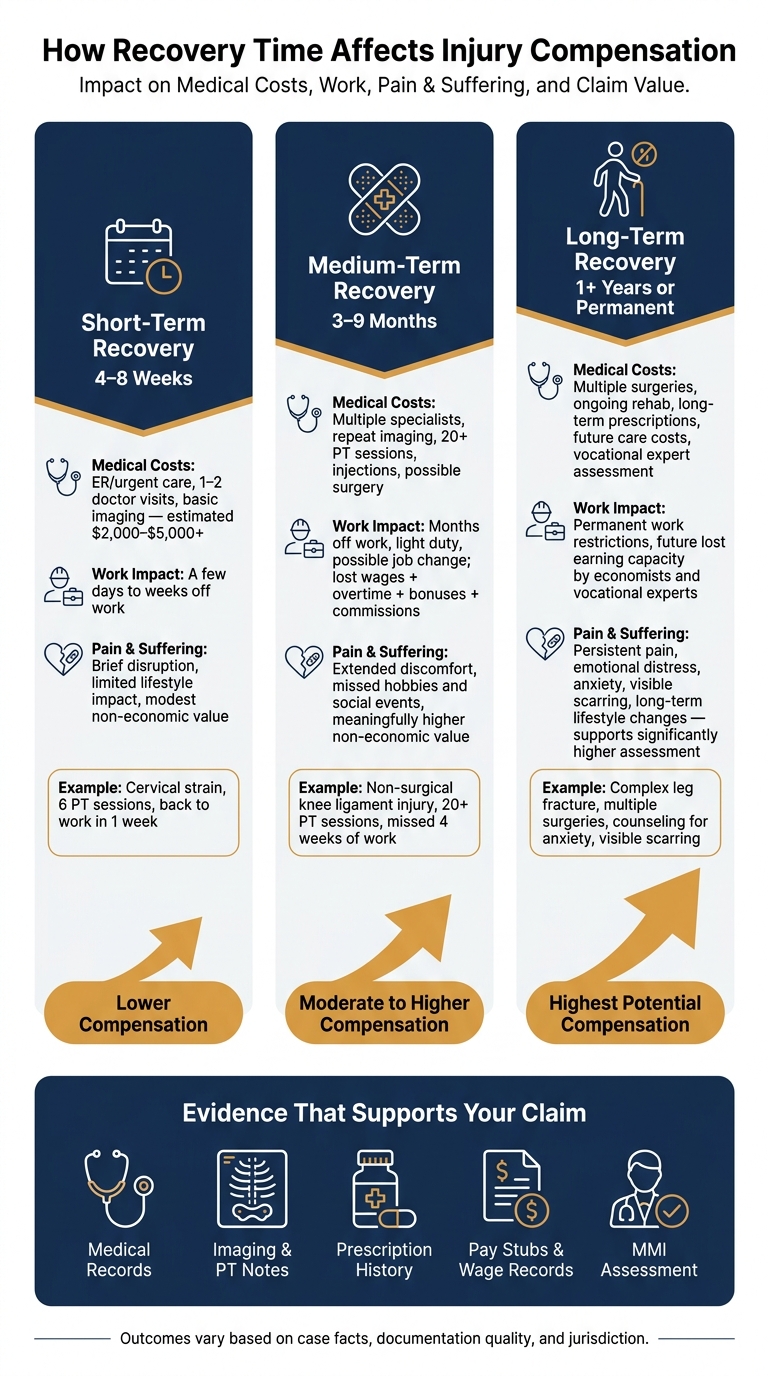
How Recovery Time Affects Injury Compensation: Short vs. Long-Term Claims
How a Longer Recovery Increases Economic Damages
A longer recovery usually means two things right away: more medical bills and more time away from work. And once treatment stretches from a few weeks into many months, those costs can stack up fast.
How Medical Bills Add Up When Treatment Lasts Months Instead of Weeks
A soft-tissue strain that clears up in 4 to 6 weeks often involves one emergency room visit or urgent care evaluation, one or two follow-up appointments, and a short round of medication. A single ER visit can cost $2,000 to $5,000+.
But a herniated disc or fractured bone that takes 6 to 12 months to treat is a different story. It can involve specialist visits, repeat MRIs, physical therapy, injections, surgery, and long-term prescriptions. What starts as one injury can turn into a long trail of bills.
| Recovery Duration | Typical Treatment Pattern | Likely Cost Categories | Work Impact |
|---|---|---|---|
| 4–6 weeks | ER/urgent care, 1–2 doctor visits, short-term meds | Initial exam, basic imaging, limited follow-up | A few days to weeks off work |
| 6–12+ months | Multiple specialists, repeat imaging, 12–30+ PT sessions, injections, possible surgery, long-term meds | High medical bills, ongoing rehab, prescriptions, transportation | Months off work, light duty, possible job change |
The gap between these two paths can be huge. A short recovery may bring a few bills and brief time off. A long recovery can mean repeat appointments, rehab costs, travel to treatment, and medication expenses that keep showing up month after month.
How Lost Wages and Earning Ability Depend on Time Away from Work
When an injury keeps you out of work for a few weeks, lost wages are usually pretty simple to figure out. Pay stubs and a letter from your employer often do the job.
Once recovery drags into months, things get more complicated. You may lose:
- Regular wages
- Overtime
- Bonuses
- Commissions
If you come back on light duty or reduced hours, the difference between what you earned before the injury and what you earn now may also be part of the claim.
If your limits last for the long haul or become permanent, the claim can also include future lost earning capacity. In those cases, vocational experts and economists often measure the gap by comparing projected pre-injury earnings with what you can realistically earn after the injury.
Longer recovery can increase both past income loss and future income loss. It can also affect pain and suffering.
sbb-itb-68ed374
How Recovery Time Affects Pain and Suffering Value
Recovery time plays a big role in pain and suffering. The longer symptoms last, the longer daily life tends to stay off track.
Why Injuries That Heal Quickly Are Often Valued Lower
If an injury gets better in a few weeks or within a couple of months, insurers and juries often put a lower value on the claim. A short treatment period, a fast return to work, and no lasting limits usually suggest lower non-economic damages.
Why Months or Years of Symptoms Can Support Higher Non-Economic Damages
A longer recovery paints a very different picture. When symptoms stick around for months or years, the injury can affect day-to-day life in a much deeper way. Decision-makers may look at things like ongoing pain, sleep loss, anxiety, limited mobility, scarring, and missed activities. The longer those problems last, the more they can shape the pain-and-suffering part of a case.
The table below shows three common recovery timelines and how they can affect pain and suffering:
| Recovery Duration | Hypothetical Scenario | Key Pain & Suffering Factors |
|---|---|---|
| Short-term (4–8 weeks) | Cervical strain from a rear-end collision; 6 PT sessions; back to work in 1 week | Brief disruption; limited lifestyle impact; modest non-economic value |
| Medium-term (3–9 months) | Non-surgical knee ligament injury from a slip-and-fall; 20+ PT sessions; missed 4 weeks of work; restricted sports | Extended discomfort; missed hobbies and social events; meaningfully higher non-economic value |
| Long-term (1+ years or permanent) | Complex leg fracture from a multi-vehicle crash; multiple surgeries; ongoing pain; counseling for anxiety; visible scarring | Persistent pain, emotional distress, and long-term lifestyle changes; often supports significantly higher pain-and-suffering assessment |
These scenarios are illustrative only and do not imply specific dollar amounts. Actual outcomes depend on the facts of each case, the quality of documentation, and the jurisdiction. In many cases, each added month of symptoms can push non-economic damages higher. The next question is what records prove the full recovery timeline.
Short-Term vs. Long-Term Recovery: What Evidence Makes the Difference
Records That Show the Full Recovery Timeline
When recovery time affects claim value, proof becomes the whole ballgame. Without solid records, even a serious injury can be brushed off as something small.
The records that matter most usually include emergency room records and visit summaries, specialist notes, diagnostic imaging like X-rays, MRIs, or CT scans, physical therapy progress notes, and prescription history. Put together, they show the full timeline: when treatment began, how it changed, and how long it lasted. A few visits over one month tells one story. Surgery, repeat follow-ups, and a year of rehab tells another.
Physical therapy notes can carry a lot of weight. They often include range-of-motion measurements, strength testing, 0-to-10 pain scores, and functional milestones. If those pain scores stay high for months, that pattern can support a stronger non-economic damages claim. Prescription records can help too. Refill history for pain medication, anti-inflammatories, muscle relaxers, sleep aids, or nerve pain medication over a long stretch may point to chronic pain instead of a short flare-up.
On the income side, pay stubs from the 3–6 months before the accident, employer wage verification letters, and doctor work-restriction forms help tie the medical timeline to lost earnings. Those forms may show limits like no lifting over 20 lbs or staying off work until a stated date. For people in physically demanding jobs like construction, healthcare, or manufacturing, that paper trail can matter a lot.
Why Settling Before Recovery Stabilizes Can Lower Your Compensation
If recovery is still changing, a settlement can leave out future costs and work limits. In plain English, the same records that prove how long recovery lasted also show why settling too soon can backfire.
Once recovery reaches MMI, future care needs and long-term limits are easier to estimate. After you sign a release, the claim usually ends. So if what looked like a simple whiplash case later turns out to involve a disc herniation that needs injections or surgery, those added costs usually fall on the injured person. The same goes for a knee injury that later needs a meniscus repair and months of rehab.
Waiting until MMI gives a clearer picture of future medical care, permanent work limits, and lasting effects on daily life. And yes, those facts can push claim value higher. At that stage, you can also get a formal impairment rating, which helps put a number on how serious and long-lasting the injury is.
Conclusion: How Recovery Time Shapes the Full Value of a Claim
Recovery time shapes claim value because it affects medical bills, lost income, and pain-and-suffering damages. When an injury causes lasting limits, future losses can push compensation higher.
But that timeline only matters if the records back it up. Documentation connects recovery time to damages. Medical records, bills, wage records, and symptom journal notes show how long the injury lasted and how it changed day-to-day life. Those same records that show treatment length also help support the final damages amount.
Put simply, compensation can go up or down based on both the length of recovery and the proof behind it.
Key Takeaways for Injured Individuals and Families
For injured people and their families, a few points stand out:
- Longer recovery often means higher medical bills, more lost wages, and stronger non-economic damages.
- Short recoveries often support lower claims, while longer treatment, surgery, or permanent restrictions can support more compensation.
- Complete records matter. Every medical visit, prescription refill, missed workday, and symptom journal entry helps show how the injury affected your life over time.
- Settling too early can be risky. If you settle before recovery levels off or before a doctor has assessed your long-term prognosis, future costs and limits may not make it into the final amount.
- Legal guidance tied to your recovery timeline can make a meaningful difference. Ocala Injury Law offers free consultations and individualized guidance for prolonged or complicated recovery claims.
FAQs
How does maximum medical improvement affect settlement timing?
Maximum medical improvement (MMI) means a condition has stabilized, and doctors don’t expect major further recovery.
This often affects when a case settles. Why? Because insurers and attorneys use MMI to get a clearer picture of future medical costs and a person’s physical limits. Without MMI, future damages and recovery are harder to pin down, so settlement may be delayed until the medical evidence is more complete.
What records best prove a long recovery?
Keep a daily recovery journal that tracks your pain levels, what you can and can’t do, and how your recovery changes from day to day. It may feel small in the moment, but that kind of record can paint a clear picture of what life has looked like since the injury.
You should also collect all of your medical records, including:
- Emergency room or urgent care records
- Follow-up visit notes
- Prescription records
- Recommended therapy or treatment plans
Medical experts can review these records, confirm that more care is needed, and explain your long-term medical needs and future medical costs.
Can I recover compensation for future lost earning capacity?
Yes. You may recover compensation for future lost earning capacity in a personal injury claim.
This falls under special damages. It covers the long-term financial effect an injury can have on your ability to earn a living, not just the paychecks you’ve already missed.
Medical experts often play a big part here. They can assess your functional limits and provide objective evidence to help estimate those future losses.