
Yes – workplace safety rules can lower injuries, but the drop is strongest when inspections lead to citations and fines. If I had to boil the research down to a few points, it would be this:
- OSHA enforcement matters most when there are penalties
- Fall protection has some of the clearest links to fewer injuries
- State safety laws can help, but results change by industry
- Injury data is not always clean because reporting rules and underreporting can distort the numbers
- In legal cases, repeat and willful violations often carry the most weight
In other words: rules alone do not cut harm. Enforcement, employer response, and how injuries get reported all shape the outcome.
A few facts stand out. OSHA tracks cases through Forms 300, 301, and 300A. Violations can be labeled serious, willful, repeat, or other-than-serious. And while long-term U.S. injury rates have gone down, the research does not tie that drop to one rule or one agency action by itself.
If you want the short answer before reading the full piece, here it is: safety laws help most when they target clear hazards, carry actual consequences, and are backed by clean reporting data.
What Studies Show About OSHA Inspections, Citations, and Penalties
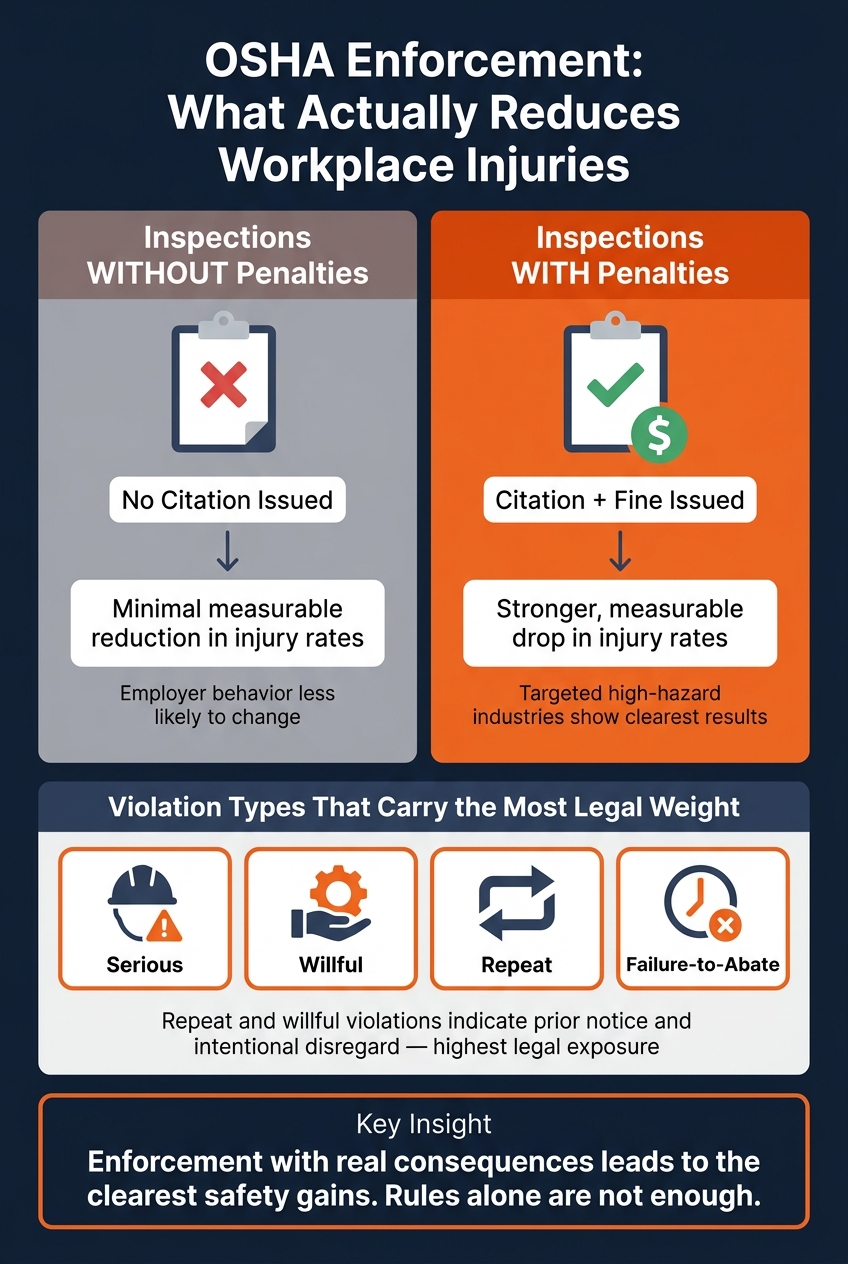
OSHA Enforcement: What Actually Reduces Workplace Injuries
The next issue is which kinds of enforcement actually change employer behavior. Study after study points in the same general direction: not every OSHA inspection leads to the same outcome. When an inspection ends with a citation and a penalty, injury rates tend to drop more than they do after an inspection with no enforcement action.
Inspections With Penalties Show the Clearest Injury Reductions
Research keeps finding a stronger drop in injuries after inspections that lead to citations and penalties. Put simply, inspections tied to penalties have a bigger effect than inspections that end with no citation.
That helps explain why later research looks beyond the fact that an inspection happened. Instead, it pays closer attention to inspection intensity and what the agency actually did.
Why the Effect Varies by Employer Size and Time Period
The effect isn’t the same in every case. It changes based on employer size, industry risk, and whether enforcement is targeted or routine. Targeted inspections in high-hazard industries are easier to study because researchers can compare similar inspected and uninspected worksites.
Those differences matter. Results depend a lot on who got inspected and when the inspection happened.
How Researchers Reached These Conclusions
To test these effects, researchers match enforcement records with later injury outcomes. They look at injury rates before and after enforcement, and they compare cited worksites with uncited ones.
That matters because OSHA enforcement is only one part of the picture. Injury rates can also change when workforce composition shifts, new tools and equipment come into use, or the industry mix changes at the same time.
sbb-itb-68ed374
Findings on Specific Safety Standards and State-Level Rules
Beyond OSHA inspections, researchers have also looked at whether specific safety rules cut injury rates. The short version: it depends on the rule.
Some standards show a clearer link to fewer injuries. Others look less steady in the data. And sometimes the rule may help, but shifts in reporting make the injury trend harder to read.
Fall Protection and Required Training in Construction
Fall protection stands out as one of the best-supported standards in the research. The clearest evidence comes from construction, where fall hazards are easier to track and measure than many other job-site risks.
Put simply, if you’re trying to find a safety standard with the strongest research backing, fall protection is near the top of the list. Among the rules studied, it has the clearest tie to lower fall-related injuries.
Other standards don’t show the same level of consistency.
Lockout/Tagout and Other Standards With Mixed Results
Lockout/Tagout (LOTO) – the procedure requiring machinery to be secured before maintenance – is meant to stop injuries caused by equipment that suddenly starts up or releases stored energy.
On paper, that makes perfect sense. In practice, the research is mixed. Some studies point to gains, while others don’t show the same pattern as clearly.
Mandatory Safety Committees and State Safety Laws
At the state level, safety rules often center on reporting, safety committees, or anti-retaliation protections. These rules can help workers speak up about hazards and can improve hazard reporting, but the findings vary by industry.
That variation matters. A rule may be helping workers report problems more often, yet that same shift can muddy injury data. When reporting changes, the numbers may move in ways that don’t neatly show whether the rule itself cut injuries.
Injury Trends, Recordkeeping Changes, and Why the Data Can Be Hard to Read
Long-Term Injury Rates Have Fallen, but Not for One Reason Alone
U.S. workplace injury rates have dropped over time. That sounds simple on the surface, but the story behind the numbers is not.
Even when safety rules do their job, headline injury rates can move for reasons that have little to do with enforcement alone. No single regulation explains the decline. Instead, several forces have likely worked together, including targeted OSHA programs, updated PPE rules, and tougher enforcement for willful violations.
Construction deaths involving vehicles and mobile heavy equipment also fell sharply over time. So yes, the data point to progress. But regulations are only one piece of the puzzle.
How Recordkeeping Rule Changes Affect Reported Rates
Reported injury trends can also change even when the job site itself hasn’t changed much. That’s where things get tricky.
OSHA’s Standards Improvement Project updates recordkeeping rules it views as unclear or outdated. When those rules change, the definition of a recordable injury can change too. And once that happens, year-over-year comparisons start to get shaky. You may be looking at a shift in paperwork, not a shift in actual harm.
The reporting rules have changed in other ways as well. Large employers once had to submit detailed injury data electronically. OSHA later rescinded that rule, though employers still must keep records on-site and file Form 300A summaries.
Then there’s the underreporting problem. Injury numbers can look lower when employers discourage workers from reporting injuries or misclassify workers as contractors. On paper, that can make the data look better than conditions on the ground.
That’s why legal analysis has to separate actual safety gains from changes in reporting. Those measurement problems shape how lawyers and researchers assess the effect of changing safety laws.
Evolving Safety Laws and What the Research Means for Legal Analysis
How Legal Professionals Use Regulatory Research in Workplace Injury Cases
What gets reported matters in court too. Safety rules don’t just guide job sites. They also shape injury claims in a direct way.
When someone gets hurt, attorneys look at the rules that applied at that exact time and ask a simple question: Did the employer follow them or not? That record helps frame notice, foreseeability, and the standard of care.
Repeat citations matter even more. They can show the employer had already been warned about the same hazard and still failed to deal with it. That’s why repeat, willful, and failure-to-abate violations often carry the most legal weight. They point to prior notice, intentional disregard, or a decision not to fix a known danger.
In severe trenching cases, that history can do more than support a civil claim. Prior violations may also support criminal exposure when the conduct shows reckless disregard. Criminal charges can follow severe safety violations, and that risk is part of what gives enforcement its force – not just as a paper deterrent, but as a real outcome tied to how seriously employers treat known hazards.
Key Takeaways From the Research
Taken together, the studies point in one direction: enforcement with real consequences leads to the clearest safety gains.
The evidence is stronger for hazard-specific rules, such as fall protection, than for broader standards. At the same time, state laws and reporting rules can either clarify the injury data or make it harder to read. That matters because legal analysis often depends on what the record shows – and what it may be hiding.
FAQs
Why do fines reduce injuries more than inspections alone?
Fines tend to work as a stronger deterrent because they hit employers where it hurts: their bottom line. An inspection can spot unsafe conditions, but by itself, it may not create the same immediate pressure to act.
A fine changes that. It adds a direct financial cost to safety failures, which can push employers to fix violations faster and avoid paying even more later.
Which safety rules are most strongly linked to fewer injuries?
The rules most closely tied to fewer workplace injuries focus on three things: steady hazard identification, thorough employee training, and proper safety equipment.
OSHA standards sit at the center of this. They require employers to keep workplaces free of hazards, provide protective gear, and clearly explain safety procedures.
Rules for equipment maintenance, lockout/tagout, and proper machine operation also help prevent severe accidents.
How can underreporting distort workplace injury data?
Underreporting workplace injuries leaves a big blind spot in workplace safety. It can hide how often hazards show up and how bad they are. When employers don’t record work-related injuries or illnesses, or they wait too long to report them to agencies like OSHA, the official numbers can miss the actual level of risk.
Accurate record-keeping matters. Missing or delayed documentation can make it harder for an injured worker to get benefits and protect their legal rights.