
If a settlement offer is too low, I should not accept it on the spot. I need to compare it to my medical bills, lost pay, property damage, out-of-pocket costs, and any future treatment before I reply. In many injury claims, once I sign a release, the case is over.
Here’s the short version:
- Read the offer line by line and check what it covers
- Match it to my records to see what was left out
- Wait until treatment is done or until my doctor can estimate future care
- Ask the adjuster for a written breakdown of how they reached the number
- Send a written counteroffer with proof attached
- Keep all contact in writing
- Move it up the chain or talk to a lawyer if the insurer will not make a proper adjustment
A low first offer is often just a starting point. According to industry data, many claims settle only after back-and-forth negotiation, not after the first number. So if the insurer offers $12,500 and my records show $40,000+ in losses, that gap needs a written response backed by documents.
The main point: I should document, challenge, counter, and only then decide.
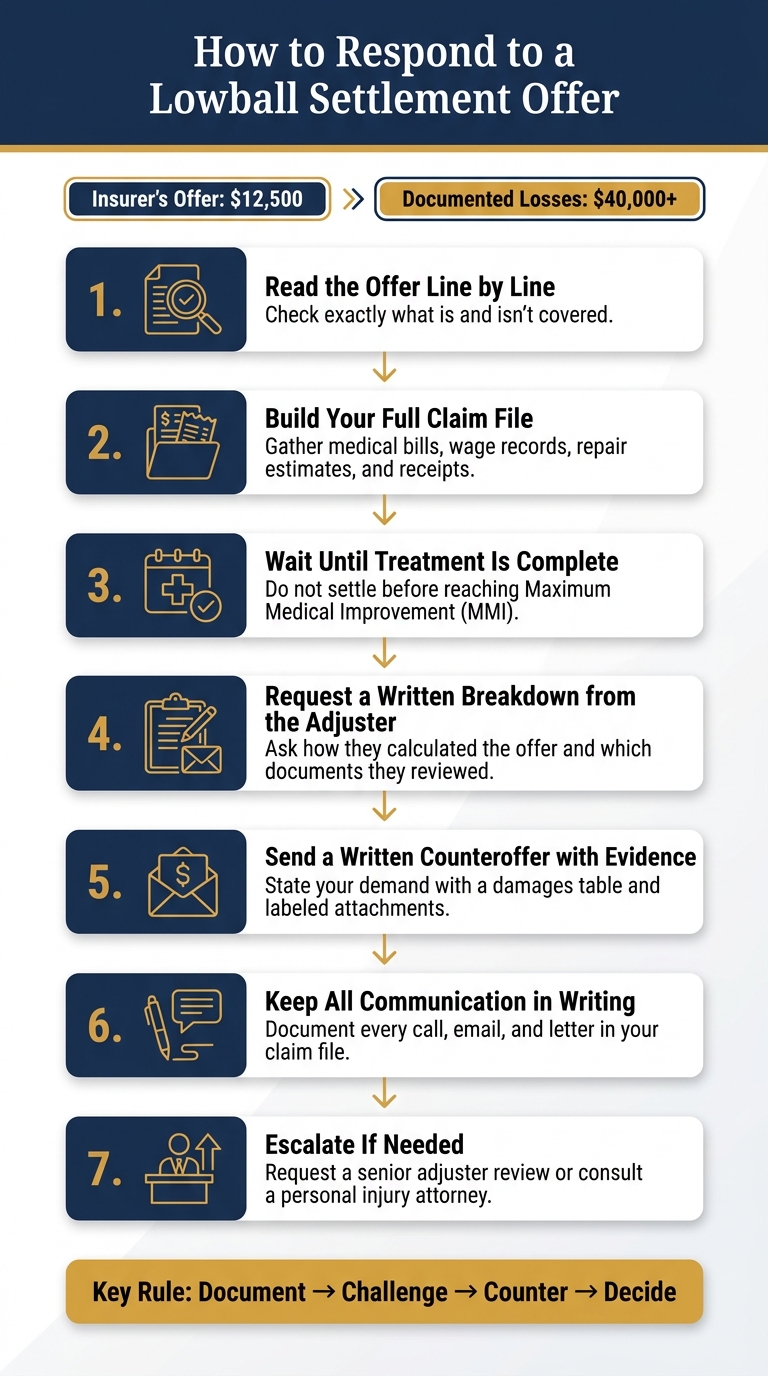
How to Respond to a Lowball Settlement Offer: Step-by-Step
Review the Offer and Gather Your Full Claim File
Before you answer the offer, put together your full claim file. That sounds basic, but it matters a lot. An offer can come in low simply because the insurer didn’t get all of your records.
You can’t judge the offer on its own until you know exactly what the insurer reviewed. That file sets the stage for your written reply and any counteroffer you send.
Compare the Offer to Your Documented Losses
Pull every loss into one total. Put your numbers in one place so you can compare them to the offer line by line.
That includes:
- ER bills, hospital charges, specialist visits, physical therapy invoices, prescription receipts, and out-of-pocket costs such as medical equipment or transportation to appointments
- Lost wages backed by pay stubs or an employer letter showing the days you missed and your hourly wage or salary rate
- Vehicle repair estimates or replacement costs if your car or other property was damaged
If your documented economic losses already come out higher than the offer, the shortfall is plain to see even before you add pain and suffering.
Collect Records That Support Liability and Damages
Missing paperwork often leads to lower offers. If the adjuster never got your therapy notes, those charges may not have made it into the offer. If your wage proof was incomplete, they may have counted only part of your missed time.
Here’s a simple way to organize the records by what they show:
| Category | Documents to Collect |
|---|---|
| Liability | Police report, photos of the scene and vehicles, witness statements |
| Medical damages | ER records, imaging reports, specialist notes, therapy notes, itemized bills |
| Lost income | Pay stubs, employer verification letter, time-off records, tax returns if self-employed |
| Property damage | Repair estimates, invoices, total loss valuation, photos of damage |
| Out-of-pocket costs | Receipts for medications, medical equipment, transportation, home care |
After your file is complete, compare it against any acknowledgment emails or letters from the insurer. If something major is missing from their file, send it over with a short cover note that lists each attachment. Then keep proof that you sent it.
Those records will back up the counteroffer you send next.
Once the file is complete, ask the adjuster to confirm what they used.
Check Whether Your Treatment Is Complete Before Settling
Before you give a detailed reply, make sure your medical picture is complete. Do not settle before treatment is complete. A personal injury settlement is almost always final. Once you sign a release, you usually can’t come back later and ask for more money.
Ask your treating physician whether you’ve reached maximum medical improvement (MMI), the point when your condition has stabilized. If you haven’t, ask for a written treatment plan that shows the care you still need and the expected cost.
That may include future physical therapy, follow-up imaging, possible procedures, and long-term medications. Those aren’t small details. They carry real dollar amounts, and they belong in your claim.
If treatment is still unfinished, your damages have not been fully valued yet. Settle too soon, and you may end up paying those later costs out of your own pocket.
sbb-itb-68ed374
Ask the Adjuster to Explain the Offer in Writing
Once your records are in order, ask the adjuster to show exactly how they came up with the offer. A written breakdown can bring missing records, shaky deductions, or disputed facts into plain view. It also gives you something solid to use when you prepare your counteroffer.
Request the Calculation Method and Any Deductions
Send a short, professional email or letter with your claim number and the date of the offer. Ask for a detailed, itemized breakdown of how the insurer valued your claim, including:
- the medical bills and records they considered and the amounts allowed
- the lost wages or income they included and how they calculated them
- how they valued pain and suffering or other non-economic damages
- how they assessed fault
- any fault percentage assigned to you and the reason for it
If the adjuster cut your claim based on comparative fault, ask what facts or documents support that decision. That gives you a clear target if you need to push back on weak assumptions.
The breakdown should line up with the documents in the file.
Confirm Which Documents the Insurer Actually Received
Ask the adjuster to list the documents now in your claim file, including medical records, bills, wage proof, photos, police reports, witness statements, and any notes or summaries of your statement. They should identify each item by provider name, date of service, and date received.
Then compare that list against your own records. If something is missing, resend it in a neat package with a cover letter that names each attachment and says how it affects your claim. Use a delivery method that gives you proof of receipt, such as certified mail or portal submission with delivery confirmation. That way, you can show when the insurer got the full file.
Use this explanation to catch missing items before you draft your counteroffer.
Write a Counteroffer Backed by Evidence
A written counteroffer gives you a clean way to show why the offer is too low and what amount you will accept. The key is simple: use the adjuster’s breakdown to point out the gaps.
Use a Clear Counteroffer Letter Format
Keep the letter short and easy to follow. Put your name, address, phone number, email, the date, and your claim number, policy number, and date of loss at the top. That helps the adjuster match it to your file right away.
Build the letter around the holes in the adjuster’s breakdown:
- Acknowledge the offer: State the exact amount and date of the offer. For example, note that on August 1, 2026, the insurer offered $12,500 to resolve your bodily injury claim.
- Reject it plainly: Stick to the facts. Explain that after reviewing the offer against your documented medical expenses, wage losses, and ongoing symptoms, you can’t accept it as a full and final settlement.
- State the missing or disputed items: Call out the exact gaps, such as missing medical bills, uncounted lost wages, disputed fault, or other valuation issues, using the breakdown you requested from the adjuster.
- State your counter-demand: Give a firm number tied to your records, such as a $55,000.00 demand to settle your bodily injury and related damages.
Close by stating that all supporting records are attached and that you expect a fair review.
Include a Damages Breakdown and Supporting Attachments
List your losses by category. Before the table, briefly mention any liability proof that supports your position, such as a crash report, witness statement, photographs, or traffic citation. Do that first so fault is addressed before you move into damages.
Then match each category to the items the insurer left out or priced too low:
| Category | Documented Amount |
|---|---|
| Medical treatment to date | $28,450.37 |
| Lost wages (6 weeks) | $6,800.00 |
| Property damage and rental car | $4,250.00 |
| Other out-of-pocket expenses | $900.00 |
| Pain and suffering | $14,599.63 |
| Total counter-demand | $55,000.00 |
If you include pain and suffering, connect that number to your injuries, how long treatment lasted, and the limits you still deal with. It also helps to add an exhibit that compares the insurer’s numbers with yours by category.
Label each attachment clearly and cite it by number in the body of the letter. For example:
"Attachment 1: Medical Bills Summary – Ocala Regional Medical Center."
Send the package by certified mail with return receipt, or through the insurer’s portal with delivery confirmation, so you have proof it was received.
After you send the counteroffer, keep the next response in writing so you can decide whether to keep negotiating or escalate.
Negotiate in Writing and Know When to Escalate
Keep Each Response Brief, Professional, and Documented
Once you send your counteroffer, keep the next exchange tight and in writing. If the adjuster calls, write down what was said and send a short follow-up note after. For example: "On 08/16/2026, you offered $12,000 and requested updated therapy records by 09/01/2026." One small step like that can save you a headache later if anyone disputes the details.
Only lower your demand after the insurer makes a meaningful move. Small, careful reductions tied to actual progress in the negotiation help protect your position and show you’re taking the process seriously.
Save every new letter, email, portal message, and call note in your claim file. That paper trail can matter a lot if the case heads to litigation or if you need to show a pattern of delay or cuts that aren’t backed up.
Escalate If the Insurer Will Not Make a Fair Adjustment
If the next reply still brushes past your records, move the matter up step by step. A few red flags tend to show up fast:
- Offers barely change even though your medical records are strong
- Their explanation shifts from one letter to the next
- There are long delays with no clear reason
- They refuse to address certain categories of damage
Start by asking for a written review from a senior adjuster or supervisor. Attach your evidence again, and point out the exact gaps between their numbers and your documented losses. If that still doesn’t lead to a meaningful adjustment, talk to a personal injury attorney.
Conclusion: Protect Your Claim Before You Accept
Do not sign a release until the offer matches your documented losses. Document, counter, escalate, then decide – in that order.
FAQs
What if the insurer ignores my counteroffer?
If the insurer ignores your counteroffer, keep clear, dated records of every call, email, letter, and message. Put everything in order so the timeline is easy to follow. No response does not automatically mean the talks are over.
It may also help to speak with a personal injury attorney. A lawyer can review what happened, look at why the insurer has gone quiet, and help make your case stronger. Ocala Injury Law provides personalized advocacy during these negotiations.
Can I negotiate before my treatment ends?
Yes, in most cases you can. But it’s often smarter to wait until you and your medical experts have enough records to estimate your current and future medical costs.
Don’t take a lowball offer based on an incomplete picture of your recovery. Medical experts can help link your injuries to the incident and back up your damages, so stay in touch with your attorney while treatment is still in progress.
When should I talk to a personal injury lawyer?
You should talk to a personal injury lawyer as soon as possible after an incident to help protect your rights and put your case on solid ground.
Getting legal advice early can help preserve evidence, figure out whether you have a valid claim, and deal with filing deadlines before they become a problem. Ocala Injury Law offers free consultations to talk through your situation and your options.