
If I want to prove a long-term injury claim, I need a clear paper trail from day one to today. Missing records, missed visits, and weak notes can cut the value of a case fast.
Here’s the short version: I need records that show when I got hurt, what doctors found, what treatment I had, how my daily life changed, and what care I may still need later. In many injury claims, medical costs and lost wages can reach thousands or even tens of thousands of dollars, so weak paperwork can turn into a big money problem.
The file should include:
- ER and hospital records
- Doctor and specialist notes
- Surgery and follow-up records
- MRI, X-ray, lab, and test reports
- Therapy, rehab, and pain treatment notes
- Work restrictions and symptom logs
- Past medical records for the same body part
- Bills, receipts, and wage-loss proof
- Doctor opinions on future care
- Extra records for brain, spine, or chronic pain claims
A few points matter most:
- Time order matters. I should gather records from the injury date forward.
- Gaps in treatment can hurt. Insurers often use gaps to say the injury was minor or came from something else.
- Written limits matter. Notes like “cannot lift more than 10 pounds” carry more weight than vague comments.
- Future care needs proof. If I may need surgery, therapy, or long-term medication, I need that in writing.
| What I need to prove | Records that help |
|---|---|
| The injury started with the event | ER, hospital, triage, discharge papers |
| The injury lasted over time | Follow-up visits, therapy notes, repeat imaging |
| The injury changed my life or work | Work restrictions, symptom journal, mental health notes |
| The injury cost me money | Bills, receipts, wage-loss records |
| I may need more care later | Doctor reports, treatment plans, life care plan |
If I keep the records organized and current, I make it much harder for an insurer to argue around the facts.
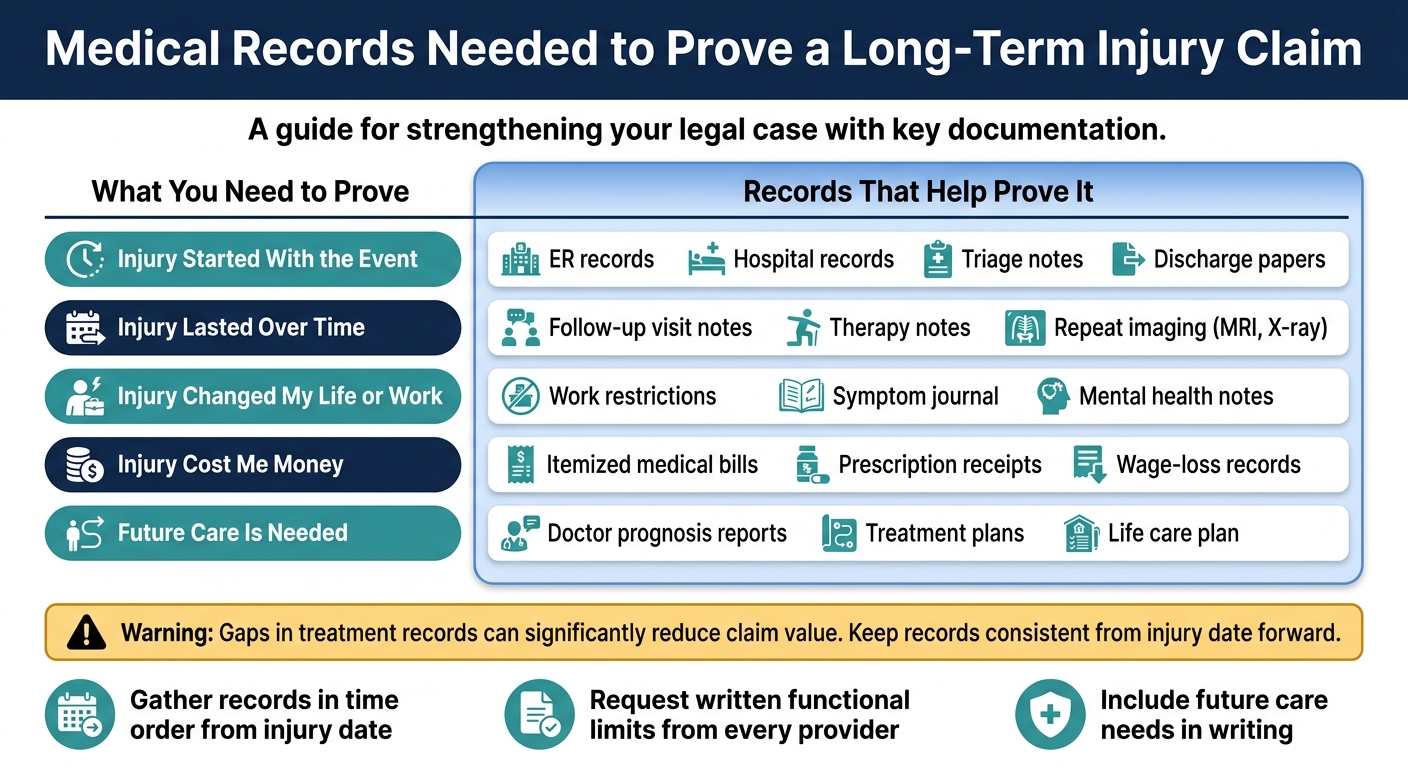
Medical Records Needed to Prove a Long-Term Injury Claim
Checklist: Core Treatment Records to Collect
Start gathering records from the date of the injury and move forward in order. That timeline matters. If records are missing, insurers can point to those gaps and argue about how bad the injury was or whether the injury came from the event at all.
Begin with emergency records, then move through each provider’s notes step by step. The basic order is:
- ER records
- Follow-up care records
- Procedure and post-procedure records
Emergency Room, Hospital, and Discharge Records
These records are the starting point. They help show when the injury happened and what the first round of treatment looked like.
Collect:
- Triage notes
- ER physician notes
- Admission records
- Nursing notes
- Discharge summaries
- Follow-up instructions given at discharge
This part of the file often sets the tone for everything that comes after it. If someone later questions timing or early symptoms, these records usually answer that.
Doctor, Specialist, and Mental Health Records
After the ER, treatment often moves to your primary care doctor, then to specialists. Gather visit notes from every provider who treated you. That includes mental health providers too.
Each note should show things like diagnoses, symptom changes, referrals, and any work or activity restrictions. Mental health records matter when pain, trauma, sleep loss, anxiety, depression, or mood changes affect recovery.
Ask each provider to describe your functional limits in plain language. For example, instead of a vague note, it helps to have something direct like:
Cannot lift more than 10 pounds, sit longer than 30 minutes, or return to full-duty work.
Surgery, Procedures, and Follow-Up Notes
If you had surgery or another procedure, collect the full record set. That usually includes operative reports, anesthesia records, procedure notes, and post-op visit notes.
Follow-up notes matter just as much. They help show what happened after the procedure, how recovery was going, and whether the treatment plan changed over time. They also help document ongoing care in a way that’s hard to brush aside later.
sbb-itb-68ed374
Checklist: Imaging, Testing, and Functional Records
These records add objective proof that backs up your treatment notes. They show what the injury looks like on paper, not just how it feels day to day. They also help show how the condition changes over time.
Imaging and Diagnostic Test Records
Gather every imaging study and diagnostic test, along with the written report for each one. That includes X-rays, MRIs, lab results, and related reports. If you have updated tests, include those too. They can help show the injury has not resolved.
Try to collect the written reports, not just the image files. The reports make it much easier to track findings over time and compare one test to the next. That paper trail helps connect the dots between symptoms, treatment, and any limits your doctor has placed on you.
Therapy, Rehabilitation, and Pain Management Records
When testing confirms the injury, therapy and pain management records help show how long recovery has lasted. Pull records from every provider involved in your care, including therapy, rehabilitation, and pain management. Keep progress notes and visit summaries that show you continued to seek care.
Treatment gaps can hurt the record. An insurer may point to those gaps and argue that the injury was not fully documented or was no longer serious. Steady treatment records help push back on that claim.
Functional Limits, Work Restrictions, and Symptom Journals
Collect any written work restrictions and provider statements that spell out what you can and cannot do. These records carry more weight when they show whether you can do your regular job, only part-time work, or modified duties.
It also helps to keep a dated symptom journal. Track pain, flare-ups, sleep loss, triggers, and missed activities. Think of it as a plain, day-by-day record of how the injury affects your life. These records also support proof of past costs and future treatment needs.
These records lead directly into proof of medical costs and future care.
Checklist: Records That Prove Past and Future Losses
After treatment records, gather the paperwork that shows what the injury has cost you so far and what it may cost later. This is the bridge between the medical facts and the money side of the claim.
Pre-Injury Medical History and Prior Similar Injuries
Pull medical records from before the injury that involve the same body part or the same condition. These records help show your starting point and make it easier to tell the difference between old issues and new damage.
Useful records include clinic notes, lab results, X-rays, MRIs, exam findings, and other diagnostic reports from before the incident. Put simply, they show what your health looked like before everything changed.
Once that baseline is in place, the next step is showing the financial hit.
Bills, Receipts, and Other Cost Records
Collect itemized medical bills, prescription receipts, and records for any other out-of-pocket costs. If the injury affected your job, include wage-loss records too, along with any proof that your earning capacity dropped.
Prognosis Reports, Future Treatment Plans, and Life Care Evidence
Future damages need paperwork too. Ask your treating physician for a written report that explains expected surgeries, continued therapy, long-term medication, or any other future care needs.
If the injury is catastrophic, include a life care plan that estimates future medical and support costs.
Add-On Checklists by Injury Type and Final Takeaways
Traumatic Brain, Spinal, and Chronic Pain Cases
Some injuries need more than standard treatment notes. On their own, routine chart entries often miss how much the injury changed day-to-day life.
Traumatic brain injury (TBI): Gather neurology notes, specialist exams, and any neuropsychological testing. Those records can show memory problems, trouble concentrating, speech issues, balance problems, and other lasting effects that may not show up in a basic office note.
Spinal injuries: Gather MRI and x-ray reports, along with specialist notes that connect the injury to physical limits. That paper trail helps show both the diagnosis and what the person can no longer do as before.
Chronic pain cases: These claims live or die on the timeline. Chronic pain needs a long record of treatment and pain management notes across months or years. If there are gaps, insurers may argue the condition is not ongoing or not severe.
Key Points to Remember Before You Request Records
Before you request records, check that the file shows the full path of the injury and recovery. It should include:
- Objective findings like MRIs, x-rays, and lab results
- Documented functional limits and work restrictions
- Evidence of future care needs
Keep treatment consistent. Gaps can weaken the claim and make ongoing symptoms much harder to prove.
FAQs
What if I missed medical treatment for a while?
Missing treatment can leave holes in your medical timeline. And that gives insurers room to argue that your injuries weren’t as serious as you say, or that you got better sooner than you claimed.
Get back into care as your doctor recommends. Show up for follow-up visits, and make sure you report all symptoms clearly and accurately. Updated medical records, along with any prognosis or treatment plan, can help connect your injuries to the incident and support claims for long-term damages.
Do I need records from before the injury?
Yes – if they relate to causation or pre-existing conditions.
Include full records for any part of your medical history that could affect the injury claim, such as earlier diagnoses, prior injuries, or other health conditions.
You should also keep treatment records that show:
- how the incident caused your injuries
- the care you received after the incident
- a clear timeline of diagnosis, testing, and treatment, especially for long-term needs
That paper trail matters. It helps connect the incident to your injuries and shows what treatment you’ve needed since then.
How do I prove I will need future medical care?
You generally need reasonably certain evidence, not just a mere possibility. Build a clear record that ties your current injuries to the accident through medical records, follow-up visits, and documented symptoms over time.
Then back that up with treatment plans from your doctor or specialist, prognosis reports, and, when it fits, expert testimony or a life care planner’s projections showing that the care is likely needed and connected to your injury.