
A mediator does not decide your injury case – the mediator helps both sides try to settle it. If you are in mediation, you still control whether you accept a deal, while the mediator manages the talks, keeps them private in most cases, and pushes each side to look hard at risk, proof, and money.
Here’s the short version:
- The mediator is neutral. They do not take sides, give legal advice, or force a settlement.
- Mediation is private in most situations. In Florida, mediation communications are generally confidential, with some narrow exceptions.
- You stay in control. No one can make you settle unless you agree to the terms.
- The process usually has 3 parts: prep, private negotiations, and either a written deal or an impasse.
- Good preparation matters. Medical bills, wage loss records, photos, reports, insurance details, and future care estimates can shape the number.
- Mediators use tools like reframing and reality testing. In plain English, they calm the language down and ask hard questions about what could happen at trial.
- Mediation can cost less than trial and may resolve a case in months instead of years, but it does not work in every claim.
- A mediator is not the same as a judge or arbitrator. A judge or arbitrator can decide the case. A mediator cannot.
If you want the simplest takeaway: the mediator’s job is to help people talk settlement in a structured way, not to rule on fault or damages.
| Role | What they do | Can they decide the case? |
|---|---|---|
| Mediator | Helps both sides negotiate | No |
| Arbitrator | Hears the dispute and issues a decision | Yes |
| Judge | Rules on legal issues and may enter judgment | Yes |
One point stands out: in a personal injury mediation, process control stays with the parties, while the mediator works to move the discussion toward a possible settlement.
Mediator Duties, Limits, and Ethics
Early settlement talks work best when the mediator stays neutral, guards confidentiality, and sticks to clear limits. A mediator runs the process, not the outcome. They keep the discussion organized, on track, and voluntary, but they cannot decide the claim.
Neutrality, Impartiality, and Conflict Checks
Florida defines impartiality as no favoritism or bias in speech, conduct, or appearance. That matters a lot in personal injury mediation, where one side may have more pressure, money, or leverage than the other. In that setting, neutrality helps injured people feel the process is fair.
Before taking a case, a mediator should look for any relationship that could create a real or perceived conflict. That can include:
- prior representation
- business ties
- personal connections
- any other conflict that creates an appearance of bias
If there’s a possible conflict, the mediator should disclose it right away. But under Florida’s rules, disclosure by itself doesn’t solve everything. If the conflict clearly affects the mediator’s impartiality, the mediator must withdraw – even if both sides sign a written waiver.
Confidentiality and Florida Mediation Rules
That neutrality depends on privacy, so mediation communications are generally protected. Florida mediation communications are generally confidential and protected from disclosure, subject to limited exceptions. Federal Rule of Evidence 408 backs this up at the federal level by making statements made during settlement negotiations inadmissible to prove liability or damages.
That privacy gives both sides room to talk openly about medical uncertainty, policy limits, fault disputes, and a realistic settlement value. The point is simple: people can speak candidly without worrying that those statements will show up at trial later.
Florida law may allow court orders, damages, and attorney’s fees for knowing, willful disclosure. There are also exceptions. These include communications used to plan or commit crimes, mandatory abuse reports, professional malpractice or misconduct claims arising from the mediation, and efforts to void or reform a settlement agreement.
What a Mediator Cannot Do
A mediator cannot give legal advice, represent either side, or pressure anyone to settle. That line matters. Your attorney handles legal strategy and settlement advice. The mediator keeps the conversation moving, while the lawyer protects the client’s legal position.
Those limits also shape how the mediator runs the session itself.
sbb-itb-68ed374
How Mediators Lead the Personal Injury Mediation Process
Once the mediator’s role is clear, the process usually moves through preparation, caucus negotiation, and then either settlement or impasse.
Before the Session: Preparation, Evidence, and Case Value
Mediation usually unfolds in three stages: preparation, caucus negotiation, and either settlement or impasse. The first stage matters a lot. Good prep makes the session more productive and cuts down on wasted time.
Before mediation, attorneys usually send over mediation summaries. These lay out the facts, liability arguments, and damage estimates. The mediator reviews them ahead of time to get a sense of where the fight is. That way, nobody walks into the room cold.
The claimant also needs to come prepared with records that back up the claim. That often includes:
- Medical records and bills
- Lost wage records
- Accident reports
- Photos
- Insurer correspondence
For more serious injuries, attorneys may also bring in medical experts and financial planners to estimate future costs. That can include added surgeries, long-term physical therapy, or home modifications. And settlement value isn’t based on injuries alone. It can also turn on insurance coverage, liens, attorney fees, and the cost of future care.
All of that gives the mediator a clear map of the dispute before the first joint meeting even starts.
During the Session: Joint Meeting, Caucuses, and Offers
Most mediations start with a joint session. Both sides sit together, and the mediator goes over the ground rules. Each attorney then gets a chance to present the client’s position.
After that opening session, the mediator usually splits the parties into private caucuses. Each side meets separately with the mediator, who moves offers and counteroffers from room to room. This is where a lot of the work happens. In caucus, the mediator asks pointed questions, tests weak spots in each side’s case, and tries to narrow the gap on liability and damages.
For claimants, this part calls for some restraint. It’s usually best to let your attorney do the talking and avoid signaling urgency or making admissions. One careless comment can shift the tone of the whole session.
After Mediation: Settlement or Impasse
If the sides get close enough to make a deal, the mediator helps put the settlement in writing. The claimant signs a release that ends any further claims tied to the same injury. That release is binding, so the terms need to be clear before anything gets signed.
If no agreement is reached, the case keeps moving. Courts often require mediation before trial, so an impasse doesn’t mean the session was pointless. It just means the dispute heads into the next phase of the case.
How Mediators Help Negotiations and How They Differ From Other Neutrals
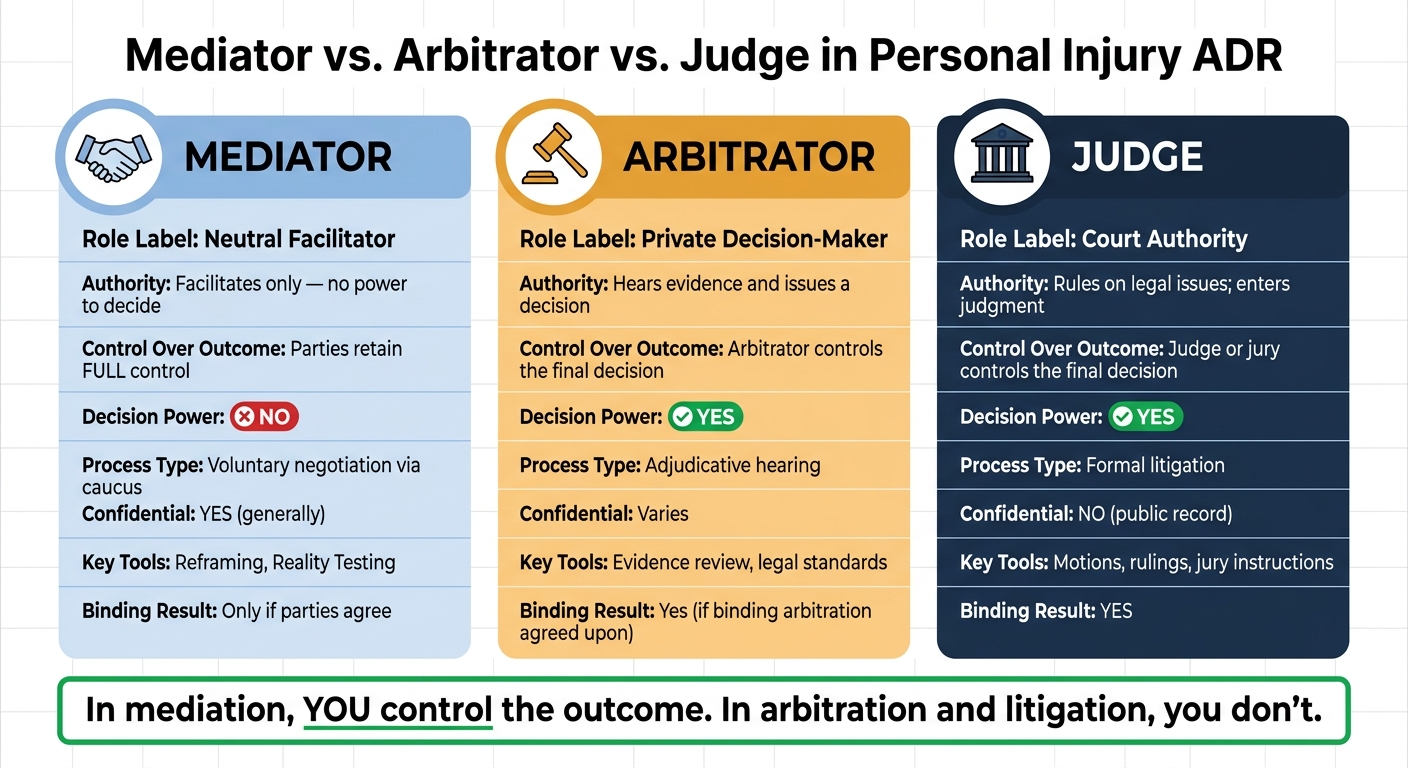
Mediator vs. Arbitrator vs. Judge: Who Controls Your Personal Injury Case?
Once a mediator moves into private caucus, communication does most of the heavy lifting.
Communication, Reframing, and Reality Testing
When talks stall, mediators often lean on two tools: reframing and reality testing.
Reframing takes a charged accusation and turns it into a neutral issue the parties can work on. If one side says the insurer refuses to pay what the case is worth, the mediator may restate that as a dispute about medical proof and future damages. That shift matters. It moves the conversation away from blame and toward the part of the case that still needs work.
Reality testing does something else. Here, the mediator asks direct questions that force each side to measure its position against what a jury might actually do. That can mean questions about comparative fault, the strength of a defense medical expert, or whether a jury might trim future treatment costs. The point is simple: get both sides to face litigation risk as it is, not as they wish it were.
Handling Emotions and Private Information in Caucus
Personal injury cases come with real emotional strain. Claimants may be living with chronic pain, lost income, or permanent disability. That pressure doesn’t stay outside the mediation room, and mediators deal with it head-on.
In practice, mediators handle strong emotions by slowing things down, setting clear ground rules early, and making sure each side feels heard. That doesn’t mean agreeing with the claim. It means keeping the claimant steady enough to make sound choices.
When emotions spike, the mediator may pause the session or move into private caucus. In caucus, a claimant can speak more openly about financial pressure, fears about treatment, or doubts about the case. That’s often where the real pressure points come out, and those pressure points can shape settlement.
Those same skills also help explain why mediators are different from arbitrators, judges, and evaluators.
Mediator vs. Arbitrator vs. Judge
The clearest line is authority: who helps the parties work toward a deal, and who gets to decide.
A mediator helps the parties negotiate but does not decide anything. An arbitrator hears the evidence and issues a decision, which may be binding or nonbinding based on the parties’ agreement. A judge has court power to rule on motions and, in a bench trial, enter judgment. A neutral evaluator offers a nonbinding opinion on case value and trial risk.
That difference in control is the main dividing line. In mediation, the parties keep control of the outcome. In arbitration and litigation, they don’t.
| Factor | Mediator | Arbitrator | Judge |
|---|---|---|---|
| Authority | Facilitates only; no power to decide | Decides the dispute | Rules on legal issues; enters judgment |
| Control over outcome | Parties retain full control | Arbitrator controls the final decision | Judge or jury controls the final decision |
How Mediator-Led ADR Can Help Personal Injury Claimants
Lower Cost, Faster Resolution, and More Privacy
These mediation tools matter for a simple reason: they can cut the day-to-day cost of settling a personal injury claim.
Mediation usually costs less than taking a case through a full lawsuit. With fewer depositions, less discovery, and fewer billable attorney hours, the savings can add up. And the timeline can be shorter too. Some claims settle through mediation in months instead of dragging on for years.
Privacy is another big plus. Mediation talks are generally confidential, which gives claimants more room to speak openly about medical history, money problems, and weak spots in the case without worrying that those statements will end up in the public record. That said, there are limits. Some details may still become public if the case moves forward in court or if court approval is needed.
Still, mediation isn’t a magic fix. If fault is heavily disputed, or the insurer won’t make a fair offer, the parties may still have to litigate after mediation. And in more complicated cases, especially those with multiple defendants or several layers of insurance, a lot of prep work may be needed before mediation becomes useful. When that happens, the cost gap can shrink.
More Control Over Settlement Terms
That flexibility is a big reason many claimants choose mediation instead of just waiting for trial.
A court judgment is mostly fixed. A mediated settlement gives the parties more room to shape terms around what the claimant actually needs. That can include lump-sum payments, installment plans, lien handling, or structured payouts. Control over when money is paid can also help avoid treatment gaps and extra debt.
Conclusion: Main Points About the Mediator’s Role
A mediator is a neutral facilitator, not a decision-maker. Their role is to organize the negotiation, protect the process, and help both sides look at their options. That’s it.
The parties keep full control over whether they settle and what the terms will be. That control can lead to faster discussions, more privacy, and terms that fit the claimant’s situation better than litigation often does.
Choosing between mediation and litigation comes down to the facts of the case, the insurance coverage in play, and what the claimant needs most: speed, privacy, flexibility, or the possible upside of a jury verdict. Mediation can come first while still leaving the door open to litigate if no fair offer comes through.
FAQs
Should I speak during mediation?
Whether you should speak during mediation is a case-by-case call that you should make with your legal counsel. Mediation involves sensitive settlement talks, and what you say can affect the path of your case. An experienced attorney can help guard your interests and make sure your comments fit your legal game plan.
Ocala Injury Law puts a strong focus on clear, open communication, so you understand your rights and responsibilities during settlement discussions.
What should I bring to mediation?
Bring any records that back up your claim and show what happened, such as:
- medical records
- incident reports
- photos or video
- a recovery journal
Good organization can make settlement talks go more smoothly. Your legal team can also review these materials and help put them in order, so your case is easy to follow and well supported.
What happens if mediation fails?
If mediation doesn’t end in a settlement, the personal injury case usually keeps moving through litigation. That can include court hearings and, in some cases, a trial.
At Ocala Injury Law, we stay focused on protecting your interests with careful case preparation, expert testimony, and strong courtroom representation.