
Most workplace accidents are not random. In many cases, they happen because of the same few problems: overexertion, falls, machine contact, chemical exposure, violence, and vehicle incidents.
If I had to sum up the article in plain English, it would be this:
- Workers get hurt most often from lifting, repetitive motion, slips, trips, falls, and contact with tools, machines, or vehicles.
- The main causes are usually fatigue, poor training, weak supervision, bad housekeeping, poor maintenance, and unsafe job setup.
- The best way to cut injuries is to fix the hazard at the source first, then use guards, ventilation, training, work rules, and PPE as backup.
- Records matter after an injury because reports, logs, video, and witness statements can show what went wrong and who knew about the risk.
- Most claims go through workers’ comp, but some cases may also involve a third party, such as a contractor, driver, or equipment maker.
Here’s the short version: if you want fewer workplace injuries, don’t just blame the worker. Look at the system, the equipment, the pace of the job, and the safety steps that were missing.
A few facts help put this in context:
- OSHA requires employers to report a work-related death within 8 hours
- Employers must also record work-related injuries and illnesses
- High-risk fields such as construction, agriculture, transportation, healthcare, retail, and warehousing face many of these hazards every day
Quick overview
| Topic | Main point |
|---|---|
| Common accidents | Overexertion, falls, slips, trips, machine contact, chemical exposure, violence, and vehicle incidents |
| Main causes | Fatigue, training gaps, poor communication, weak maintenance, blocked walkways, and output pressure |
| Best controls | Remove the hazard, replace it, isolate it with guards or ventilation, then use rules and PPE |
| What employers should keep | Incident reports, maintenance logs, training records, video, witness statements, and medical records |
| Legal side | Workers’ compensation is common, but some cases may also support a third-party claim |
Bottom line: when I look at workplace accidents, the pattern is clear – injuries drop when employers fix hazards early, train workers well, keep equipment in shape, and take near-misses as warning signs instead of ignoring them.
sbb-itb-68ed374
The Most Common Workplace Accidents and What Triggers Them
Overexertion, Repetitive Motion, and Ergonomic Injuries
A lot of workplace injuries follow the same patterns again and again. Overexertion is one of the most common causes, especially in warehouses and healthcare settings.
It usually shows up when a job involves lifting heavy loads, pushing carts, pulling equipment, or staying in awkward positions for too long. Think about warehouse order pickers, delivery workers unloading packages, or nurses repositioning patients. They deal with this risk every day.
And when the pace ramps up, the danger gets worse. In high-pressure fulfillment settings, workers may feel pushed to move faster and skip safe lifting methods just to keep up.
Falls, Slips, Trips, and Contact with Equipment
Wet floors, cluttered walkways, uneven surfaces, and poorly maintained ladders lead to a big share of workplace injuries. You see these hazards all the time in retail, hospitality, and construction.
Not every fall looks the same, though. A slip on a wet floor and a fall from height bring very different levels of harm. A wet-floor slip can lead to fractures or a head injury. A fall from scaffolding or a ladder can lead to spinal injury or death.
Then there’s equipment contact, which adds another layer of danger. Unguarded machinery, poor lockout/tagout practices, and workers stepping into a machine’s swinging radius are common triggers for hit-by and caught-between machinery incidents in manufacturing and construction.
In construction, contact with heavy equipment and machines is a major source of severe injuries.
Chemical Exposure, Workplace Violence, and Transportation Incidents
Some of the most serious workplace hazards are harder to spot at first glance. Poor ventilation can expose workers to dust, fumes, and chemicals. Agricultural workers deal with pesticide exposure and heat illness. Healthcare workers and first responders, on the other hand, face a major risk of workplace violence.
Transportation incidents are just as dangerous. Forklift operators, commercial drivers, and delivery workers face real danger when reversing, turning, and loading or unloading. That risk climbs fast when communication breaks down between operators and nearby workers.
Vehicles and mobile heavy equipment cause many construction deaths. In many cases, these incidents come from poor job design, weak supervision, or missing safety controls, not just individual mistakes.
The next issue is why these hazards keep coming back.
Root Causes: Why Workplace Accidents Keep Happening
Most workplace injuries don’t come from one bad moment. They come from stacked failures: fatigue, poor maintenance, weak supervision, and unsafe job design. Then the system breaks in more than one place at the same time, and someone gets hurt.
That’s why prevention has to deal with all of those layers together, not just the person closest to the incident.
Human Factors: Fatigue, Distraction, and Inadequate Training
People love to blame “worker error.” But in many cases, that’s only part of the story. Training gaps, poor communication, and missing PPE often sit right behind the mistake.
Take a new employee who hasn’t been shown the right way to clear debris from a machine. That worker isn’t simply making a careless choice. They’re dealing with an employer training failure.
Fatigue makes things worse fast. It slows reaction time, weakens judgment, and makes skipped steps more likely. Add production pressure on top of that, and the risk climbs in a hurry. The outcome is predictable.
Unsafe Conditions, Poor Maintenance, and Flawed Job Design
A lot of danger starts building long before an injury happens. Blocked walkways, poor lighting, missing guards, crowded work areas, and overhead obstructions all create risk. These problems usually pile up little by little, often because no one is clearly responsible for spotting them early.
Poor maintenance is a major cause too. When heavy machinery isn’t serviced on a routine schedule, small mechanical issues can turn into serious incidents. And when basic safeguards are missing, like backup alarms or rollover protection, routine tasks become high-risk ones.
Job design matters just as much. If the work setup doesn’t account for communication between operators and nearby workers, the chance of injury goes up even more. It’s a bit like sending people into traffic with no signals and hoping they sort it out.
Management Failures and Weak Safety Culture
When injuries keep happening in the same workplace, the pattern usually points back to the system, not just the people in it. Missing procedures, ignored near-miss reports, and pressure to put output ahead of safety keep the same kinds of injuries in motion.
Many accidents happen when several defenses fail at once. A supervisor doesn’t enforce lockout/tagout. A machine guard is missing. A worker hasn’t been trained on the hazard. Once those failures line up, the incident that follows isn’t a fluke. It’s the result of a system that was already broken.
These failures point directly to the best prevention methods.
Prevention Strategies That Reduce Workplace Injuries
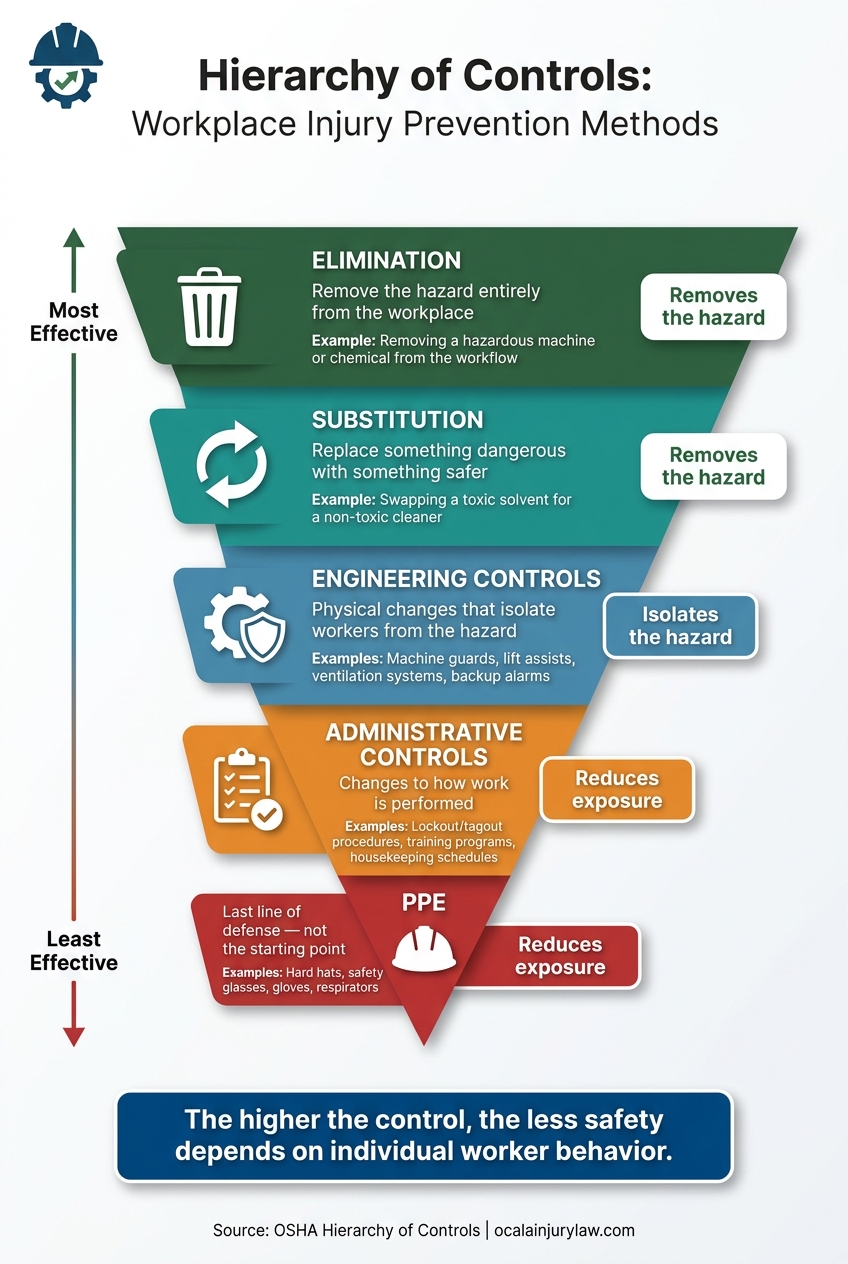
Hierarchy of Controls: Workplace Injury Prevention Methods
How to Apply the Hierarchy of Controls at Work
Workplace injuries usually don’t come from one bad moment alone. More often, they happen when several things go wrong at once. That’s why prevention has to deal with the hazard itself, the way the job is set up, and the system around it. That’s the idea behind the hierarchy of controls, a five-level framework that ranks prevention methods from most to least effective.
At the top is elimination: remove the hazard entirely. Next comes substitution, which means replacing something dangerous with something safer, like swapping a toxic solvent for a safer cleaner. These two options can be hard to put in place, but they offer the strongest protection because they remove the danger at its source.
Then come engineering controls. These are physical changes to the workplace, such as machine guards, lift assists, ventilation systems, and backup alarms on heavy equipment. They protect workers even on days when people are tired, rushed, or distracted.
Below that are administrative controls, like training programs, lockout/tagout procedures, and housekeeping schedules. These change how people do the work, but the hazard is still there. At the bottom is PPE: hard hats, gloves, and respirators. PPE is the last line of defense, not the starting point.
The farther up the hierarchy an employer can act, the less safety depends on one worker making the right move at the exact right time. And in practice, these controls work better when they’re backed by training and steady reporting.
Comparing Prevention Methods by Effectiveness and Use Case
| Control Level | Effectiveness | Implementation Difficulty | Common Examples | When to Prioritize |
|---|---|---|---|---|
| Elimination | Highest | High | Removing a hazardous machine or chemical from the workflow | At the design or planning stage of a job |
| Substitution | High | Moderate | Replacing a toxic solvent with a non-toxic cleaner | When a hazard can’t be fully removed |
| Engineering Controls | Moderate-High | Moderate | Machine guards, backup alarms, lift assists, ventilation systems | To isolate workers from the hazard at the source |
| Administrative Controls | Moderate-Low | Low | Lockout/tagout, training, housekeeping schedules | To reinforce safe behavior and change work procedures |
| PPE | Lowest | Low | Hard hats, safety glasses, and properly fitted respirators | As a final layer or temporary measure only |
The right control depends on the hazard, but the aim stays the same: reduce exposure at the source.
A simple way to think about it:
- Use guardrails for fall hazards
- Use lift assists for overexertion risks
- Use ventilation or substitution for chemical exposure
- Use machine guards for contact injuries
Why Training, Reporting, and Incident Review Matter
Even strong engineering controls can fall short if workers don’t understand the hazards around them. Regular training makes sure safety rules aren’t just sitting in a binder or posted on a wall. People need to know them, use them, and spot when something is off. That gap between policy and day-to-day practice is where many preventable injuries happen.
Near-miss reporting plays a big role here. When someone almost gets hurt but walks away unharmed, that moment still tells you something. It points to a weak spot in the system. Employers who treat near-misses as useful data, not as something to hide, have a better shot at fixing problems before they turn into injuries.
Safety rules work only when they are documented, communicated, and enforced.
Routine inspections and prompt incident reviews help pinpoint where things failed. When something goes wrong, a close look at reports, footage, witness statements, and site records can show whether it was a one-off event or part of a deeper pattern. That review also shows whether the hazard was isolated, controlled, or simply left in place. Just as important, those records can show whether the employer met its safety duties.
Legal Responsibilities, Evidence, and Key Takeaways
Employer Duties and the Role of Safety Documentation
When prevention fails, the paper trail tells the story. Records can show what hazards were there, what the employer knew, and whether the injury could have been stopped.
Under OSHA’s General Duty Clause, employers must protect workers from recognized hazards with safe equipment, clear training, hazard warnings, and written work procedures. This paperwork is more than a box to check. It helps show the hazards and breakdowns covered in this article.
Key records include:
- Incident reports
- Maintenance logs
- Training records
- Video
- Witness statements
- Medical records and exposure logs
Employers must record all work-related injuries and illnesses. They also must report any death or hospitalization to OSHA within 8 hours.
Those same records can shape the legal path of a case. In some situations, they show that a claim stays within workers’ compensation. In others, they may support a third-party claim.
How Safety Failures Can Affect a Workplace Injury Claim
Most workplace injuries go through workers’ compensation. That usually covers medical care and part of a worker’s lost wages.
But that’s not always the whole picture.
If a third party caused or helped cause the injury, a separate personal injury claim may also apply. For example, maybe a contractor, equipment maker, or outside driver played a part. Florida law can also limit recovery when a worker is mostly at fault.
Conclusion: Main Causes, Prevention Steps, and When to Seek Legal Help
After an injury, documentation matters just as much as the incident report. Write down the injury report, take photos of the scene, get witness names, and keep notes about symptoms and missed work.
If a safety failure or third party may have caused your injury, Ocala Injury Law offers free consultations.
FAQs
What is the hierarchy of controls?
The hierarchy of controls is a structured way to reduce or remove workplace hazards by putting the most effective safety measures first.
Here, that includes engineering controls like backup sensors and rollover protection systems on heavy machinery. It also includes administrative controls like required safety training, lockout/tagout procedures, and warning signs.
How can near-miss reports prevent injuries?
Near-miss reports help prevent workplace injuries because they document hazards before an accident happens. If someone reports a spill, poorly maintained equipment, or a safety lapse, the employer has a chance to fix the problem before a worker gets hurt.
They also create a written record of known hazards. That record can help employers correct unsafe conditions, enforce safety protocols, and protect employees from future injuries.
When can a workplace injury involve a third-party claim?
A workplace injury can lead to a third-party claim if the accident was caused by someone other than your employer or a coworker.
Workers’ compensation usually pays limited no-fault benefits. But a third-party claim may let you seek damages that workers’ comp doesn’t pay for, including pain and suffering.
Common examples include:
- Defective equipment
- Crashes caused by negligent drivers while you’re working
- Unsafe property conditions controlled by an outside party