
Before I sign a personal injury retainer, I check three things first: what the lawyer will do, what I may have to pay, and what happens if the case does not pay out.
This agreement is the written contract between me and the law firm. It should state who is covered, what part of the case the lawyer handles, how the contingency fee is figured, which case costs are separate, what rights I keep, and how the relationship can end. In Florida, many personal injury fee agreements follow Rule 4-1.5, and contingency fees often use rates like 33.3% before an answer and 40% on the first $1 million after an answer.
Here’s the short version of what I look for before signing:
- Parties and case details: my name, the law firm, claim type, and accident date
- Scope of work: settlement only, or lawsuit, trial, and appeal too
- Fee terms: the percentage, and whether it comes from the gross recovery or after costs
- Case costs: filing fees, records, experts, transcripts, and who pays them back
- Client duties: truthful facts, updated contact info, medical follow-through, and saving evidence
- Client rights: updates, answers to questions, and the final say on settlement
- End-of-case terms: liens, cost repayment, closing statement, and lawyer changes
If I can’t explain those points in plain English after reading the agreement, I stop and ask questions before signing.
What a Retainer Agreement Usually Covers
A retainer agreement lays out who the lawyer represents, what work is part of the deal, and which costs are billed separately.
Who the Agreement Covers and What Case It Applies To
The agreement should clearly list the client, the lawyer or law firm, the type of claim, and the date of the incident. It should also say whether the lawyer’s work stops at settlement or keeps going through litigation and trial. If appeals are part of the deal, that should be stated outright.
In Florida, these agreements are governed by Rule 4-1.5 of the Florida Rules of Professional Conduct, which sets standards for fairness and transparency.
That scope matters because it shows what work is part of the fee and what may lead to separate charges.
What Work the Lawyer Will Do
Once the scope is clear, the next step is simple: figure out what the lawyer’s fee covers and what the case itself may cost.
The agreement should draw a clean line between legal services and case costs. Legal services often include things like investigation, negotiation, filing, discovery, mediation, and trying the case. Case costs usually include:
- Filing fees
- Medical records
- Transcripts
- Service of process
- Expert fees
That split can save a lot of confusion later, especially when bills start coming in.
What Client Duties and Basic Case Rules Are Included
The agreement should also spell out what you need to do to help protect the case. In most situations, you’ll be expected to:
- Provide truthful and complete information
- Keep your contact information up to date
- Attend medical appointments and follow treatment plans
- Document the accident scene
- Get witness names
- Keep damaged personal items as evidence
- Track all accident-related expenses
One part people often skim past is the no-guarantee provision. No attorney can promise a result. That’s standard language in retainer agreements, and it ties straight back to the written fee terms. The agreement is based on what the attorney will do, not on what outcome you get.
Before you sign, check whether you may still owe advanced costs if the case ends with no recovery. Agreements don’t all handle that the same way.
sbb-itb-68ed374
How Fees, Costs, and Payout Terms Work
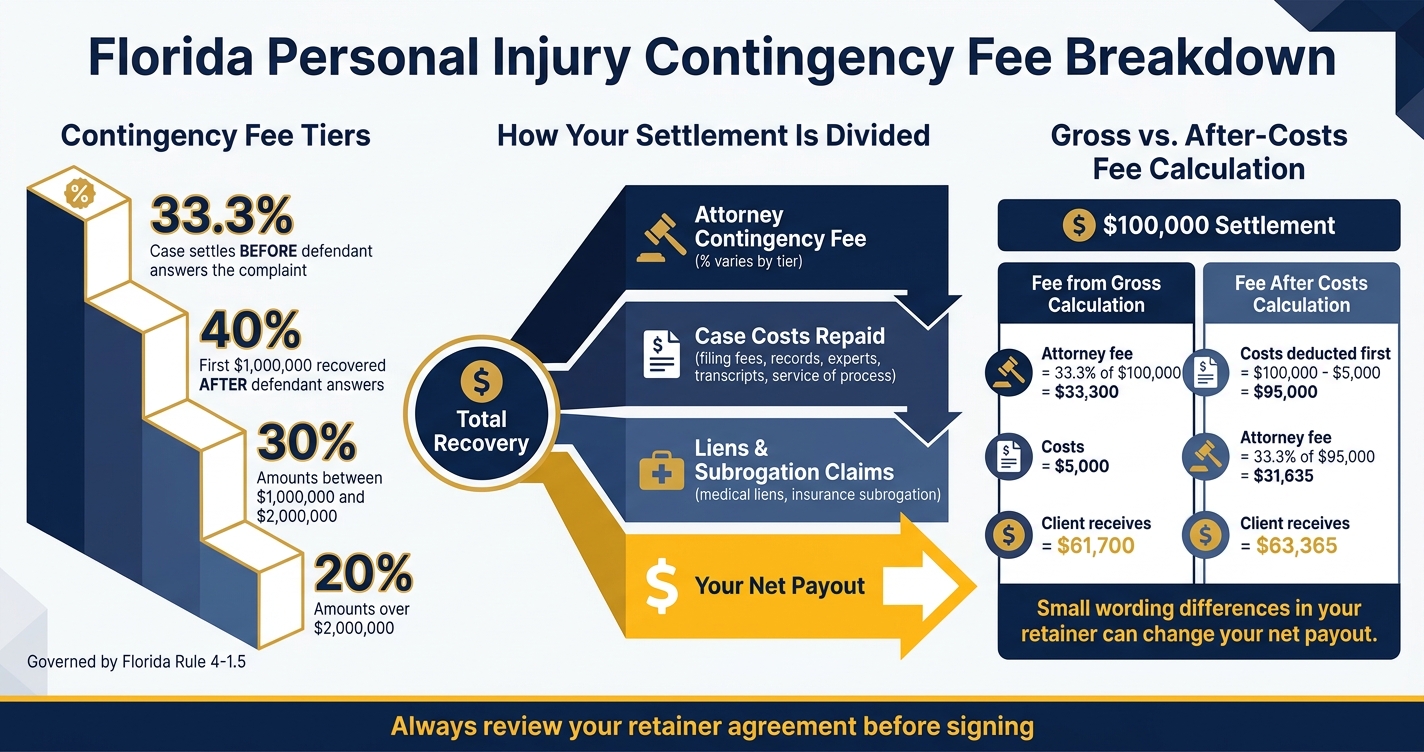
Florida Personal Injury Contingency Fee Breakdown
Once the scope of representation is clear, the agreement should show exactly how the money is split. This part covers how your attorney’s fee, case costs, and final payout are figured.
How Contingency Fees Are Calculated
A contingency fee is a percentage of the recovery your attorney gets for you, whether that comes from a settlement or a jury verdict.
In Florida, that percentage is usually capped at:
- 33.3% if the case settles before the defendant answers the complaint
- 40% for the first $1 million if the defendant answers
- 30% for amounts between $1 million and $2 million
- 20% for anything over $2 million
Your retainer agreement should also say whether the fee comes out of the gross recovery or the amount left after costs. That small detail can change your net payout in a big way.
Which Case Costs May Be Charged Separately
Attorney fees and case costs are not the same thing. Costs can include things tied to moving the case forward, and the agreement should say which of those costs are advanced, when they must be paid back, and whether you still owe them if there’s no recovery.
That shouldn’t be left to guesswork. It should be written out clearly before you sign.
How to Read Your Final Settlement Breakdown
At the end of the case, those terms should show up in a closing statement. In Florida, contingency fee matters governed by Rule 4-1.5 require a closing statement, or disbursement sheet, signed by both the attorney and the client, with all costs and fees itemized.
Your closing statement should list:
- the total recovery
- the attorney fee
- case costs
- liens
- your net payout
Ask whether liens or subrogation claims were reduced. That goes straight to what you actually take home.
Attorney Obligations and Client Rights Under the Agreement
Beyond the fee terms, the retainer also lays out how the lawyer-client relationship should work day to day. It sets the ground rules for the working relationship itself: what your attorney is supposed to do, and what protections you should have in writing from the start.
What the Attorney Is Expected to Do
Your attorney must handle your case with care by gathering evidence, getting records, and tracking down witnesses. Just as important, the attorney should explain what’s happening in plain English, give prompt updates as the case moves ahead, and present every settlement offer to you.
Attorneys should also disclose any conflicts of interest that could affect the representation and handle settlement funds the right way.
What Rights the Client Should Have in Writing
Your retainer should clearly state that you have the right to regular updates, the right to ask questions at any time, and the right to approve or reject any settlement offer. The attorney negotiates. You decide whether to settle. You should also have the right to a written final accounting.
That language shouldn’t be buried in legal jargon. It should appear clearly in the written agreement.
| Attorney Obligation | Your Corresponding Right |
|---|---|
| Clear communication and case updates | Ask questions and receive timely responses |
| Diligent investigation and representation | Access the information needed to make informed decisions |
| Explain major legal decisions | Make the final call on accepting or rejecting any offer |
| Proper handling of client funds | Receive a written final accounting |
| Disclose potential conflicts of interest | Expect loyal, conflict-free representation |
When the Relationship Can End and What Happens Next
The agreement should also explain what happens if you decide to change attorneys. You can end the attorney-client relationship at any time, though some limits may apply if a lawsuit has already been filed and the switch would cause unnecessary delay. If a lawsuit is on file, changing lawyers usually requires written notice and a Substitution of Counsel.
One point matters a lot: your total legal fees should not go up just because you switch attorneys. The contingency fee is usually split between the lawyers by agreement or quantum meruit.
Read any lien or charging lien language with care before you sign. That section can let the attorney claim part of the final settlement for unpaid fees or costs. Medical liens and subrogation claims may also still be paid from the settlement proceeds after a change in counsel. The retainer should explain fee division, liens, and transfer steps in plain language. If something doesn’t make sense, ask for clarification in writing before you sign.
Conclusion: How to Use the Agreement to Protect Yourself
After you review the scope, fees, costs, and duties, pause and run through a few final checks before you sign.
Key Points to Review Before You Sign
Start with who is actually handling your case. Make sure you know who will manage it day to day, not just whose name is on the agreement. That should be stated clearly in writing.
Next, confirm the exact contingency fee percentage and the point at which it applies. Small wording differences here can change what you owe.
Then look closely at the costs clause. Check which costs the firm will front, which ones you must pay back, and what you may still owe if there is no recovery.
Also, review how liens and subrogation claims can shrink your final payout. Ask for a sample payout breakdown so you can see the math on paper.
Last, read the exit terms with care. If the relationship ends early, you need to know what happens next, how past work is treated if you switch lawyers, and how termination and file-transfer terms work before you sign.
FAQs
Can I negotiate a retainer agreement?
Yes – you can discuss and negotiate the terms of a retainer agreement with your attorney.
In personal injury cases, contingency fees are common. That means the lawyer gets paid only if you recover money. Still, some attorneys may adjust their percentage based on the details of your case.
Before you sign anything, look closely at:
- the fee structure
- how case expenses are handled
- whether the rate changes at different stages of the case
A retainer agreement isn’t something you should skim and rush through. Read it line by line so you know what you’re agreeing to.
What if I want to change lawyers later?
You can usually end your retainer agreement at any time. That’s a standard part of most professional contingency fee contracts.
That said, the exact rules depend on what you signed. Review your agreement to see how to end the relationship and how fees and case expenses are handled after termination.
Will I owe anything if I lose my case?
In a contingency fee agreement, you usually don’t pay attorney fees if your case doesn’t win or settle.
That said, you may still need to repay out-of-pocket expenses the law firm covered up front. These can include court filing fees, expert witness fees, and the cost of getting medical records.
Your written retainer agreement should spell out how those costs are handled.